Showing posts with label sermon. Show all posts

Sunday, February 16, 2020

Reconciling Sunday

This sermon manuscript is from Trinity las Americas United Methodist Church's Reconciling Sunday worship service.  The congregation worships bilingually, so the manuscript is bilingual with Spanish in bold and English in italics.  The sermon came from the queeries I did this week.


Mateo 5:21-37
21 »Ustedes han oído que a sus antepasados se les dijo: “No mates, pues el que mate será condenado.” 22 Pero yo les digo que cualquiera que se enoje con su hermano, será condenado. Al que insulte a su hermano, lo juzgará la Junta Suprema; y el que injurie gravemente a su hermano, se hará merecedor del fuego del infierno.

23 »Así que, si al llevar tu ofrenda al altar te acuerdas de que tu hermano tiene algo contra ti, 24 deja tu ofrenda allí mismo delante del altar y ve primero a ponerte en paz con tu hermano. Entonces podrás volver al altar y presentar tu ofrenda.

25 »Si alguien te lleva a juicio, ponte de acuerdo con él mientras todavía estés a tiempo, para que no te entregue al juez; porque si no, el juez te entregará a los guardias y te meterán en la cárcel. 26 Te aseguro que no saldrás de allí hasta que pagues el último centavo.

27 »Ustedes han oído que se dijo: “No cometas adulterio.” 28 Pero yo les digo que cualquiera que mira con deseo a una mujer, ya cometió adulterio con ella en su corazón.

29 »Así pues, si tu ojo derecho te hace caer en pecado, sácatelo y échalo lejos de ti; es mejor que pierdas una sola parte de tu cuerpo, y no que todo tu cuerpo sea arrojado al infierno. 30 Y si tu mano derecha te hace caer en pecado, córtatela y échala lejos de ti; es mejor que pierdas una sola parte de tu cuerpo, y no que todo tu cuerpo vaya a parar al infierno.

31 »También se dijo: “Cualquiera que se divorcia de su esposa, debe darle un certificado de divorcio.” 32 Pero yo les digo que si un hombre se divorcia de su esposa, a no ser en el caso de una unión ilegal, la pone en peligro de cometer adulterio. Y el que se casa con una divorciada, comete adulterio.

33 »También han oído ustedes que se dijo a los antepasados: “No dejes de cumplir lo que hayas ofrecido al Señor bajo juramento.” 34 Pero yo les digo: simplemente, no juren. No juren por el cielo, porque es el trono de Dios; 35 ni por la tierra, porque es el estrado de sus pies; ni por Jerusalén, porque es la ciudad del gran Rey. 36 Ni juren ustedes tampoco por su propia cabeza, porque no pueden hacer blanco o negro ni un solo cabello. 37 Baste con decir claramente “sí” o “no”. Pues lo que se aparta de esto, es malo.

-----

Matthew 5:21-37
21“You have heard that it was said to those of ancient times, ‘You shall not murder’; and ‘whoever murders shall be liable to judgment.’ 22But I say to you that if you are angry with a sibling, you will be liable to judgment; and if you insult a brother or sister, you will be liable to the council; and if you say, ‘You fool,’ you will be liable to the hell of fire. 23So when you are offering your gift at the altar, if you remember that your sibling has something against you, 24leave your gift there before the altar and go; first be reconciled to your sibling, and then come and offer your gift. 25Come to terms quickly with your accuser while you are on the way to court with him, or your accuser may hand you over to the judge, and the judge to the guard, and you will be thrown into prison. 26Truly I tell you, you will never get out until you have paid the last penny.

27“You have heard that it was said, ‘You shall not commit adultery.’ 28But I say to you that everyone who looks at a woman with lust has already committed adultery with her in his heart. 29If your right eye causes you to sin, tear it out and throw it away; it is better for you to lose one of your members than for your whole body to be thrown into hell. 30And if your right hand causes you to sin, cut it off and throw it away; it is better for you to lose one of your members than for your whole body to go into hell. 31“It was also said, ‘Whoever divorces his wife, let him give her a certificate of divorce.’ 32But I say to you that anyone who divorces his wife, except on the ground of unchastity, causes her to commit adultery; and whoever marries a divorced woman commits adultery.

33“Again, you have heard that it was said to those of ancient times, ‘You shall not swear falsely, but carry out the vows you have made to the Becoming One.’ 34But I say to you, Do not swear at all, either by heaven, for it is the throne of God, 35or by the earth, for it is her footstool, or by Jerusalem, for it is the city of the great Queen. 36And do not swear by your head, for you cannot make one hair white or black. 37Let your word be ‘Yes, Yes’ or ‘No, No’; anything more than this comes from the evil one.

-----


La lectura de hoy es un poco difícil de oír.  Jesús tiene palabras fuertes para las personas con quien habla, pero no suena lo mismo por cada uno de nosotres.  Esta hablando en el sermón del monte a sus discípulos y a la multitud, pero la manera en que habla en esta parte significa que está hablando con personas con poder en su comunidad.  Está hablando sobre el poder—en la sociedad y,        sobre otras personas—y cómo restringirlo.

Today's reading is a little hard to hear. Jesus has strong words for the people he’s talking to, but they don’t resonate the same for each of us. He’s speaking in the sermon on the mount to his disciples among a growing crowd, but the way he speaks in this part means that he’s talking to people with power in his community. He is talking about power — in society and over other people — and how to restrict it.

As in many marginalized communities, the queer community knows a lot about power. In the sixties and seventies, when Marsha P. Johnson and Silvia Rivera led the resistance at Stonewall, they knew that the police and immoral laws against trans and queer people had the power in society. Today, while we hear of the laws appearing in Iowa and other states against trans youth in particular, we know where the power is.

Como en muchas comunidades marginalizadas, la comunidad queer conoce mucho sobre el poder.  En los años sesenta y setenta, cuando Marsha P. Johnson y Silvia Rivera dirigieron la resistencia de Stonewall, sabían que la policía y las leyes inmorales contra personas trans y queer tenían el poder en la sociedad.  Hoy en día, mientras que oímos de las leyes apareciendo en Iowa y otros estados contra jóvenes trans, sabemos dónde está el poder. 

Cada año cuando leemos los nombres y reconocemos las vidas tomadas de las personas trans, la mayoría de quienes son mujeres trans de minoría, sabemos dónde está el poder.  Este poder de matar y sacar derechos es poder individual y aun más es poder corporal.  Ese poder, en el sentido estructural, reside con personas que no son marginalizadas y se colocan en instituciones y organizaciones que ayudan a ciertas personas y oprimen a otras.

Every year when we read the names and recognize the lives taken of trans people, who are mostly trans women of color, we know where the power is. This power to kill and take away rights is individual power and moreso communal power.  That power, in the structural sense, resides not with people who are marginalized, but in institutions and organizations that help people with privilege and oppress others.

But power is not only a societal concern, but it also affects how we relate to each other.  In this part of the sermon on the mount, Jesus is speaking to people with more power on how to better relate to people with less power.

Pero el poder no solo es una cosa de la sociedad, sino también afecta como nos relacionamos unes a otres y en esta parte del sermón de la monte, Jesús está hablando a las personas con mas poder sobre cómo relacionarse mejor con personas con menos poder.

Cuando Jesús habla del homicidio y el enojo, está hablando a las personas quienes han ofendido a otra persona.  No es la responsabilidad de la víctima iniciar la resolución o reconciliación.  Es la responsabilidad de la persona que es perpetrador a pedir perdón y cambiar como actúa.  De esta manera, Jesús requiere algo de la persona con más poder en vez de añadir al peso que lleva la persona con menos poder.

When Jesus speaks of murder and anger, he is talking to people who have harmed another person. It is not the responsibility of the victim to initiate resolution or reconciliation. It’s the responsibility of the person who is the perpetrator to apologize and to change how he acts. In this way, Jesus requires something of the person with the most power rather than adding to the burden of the person with less power.

When Jesus speaks of divorce, he is telling men in a patriarchal society that they cannot divorce their wives for any old reason. Because the divorce will leave the woman without resources. When Jesus speaks of adultery, he is talking to men, who objectify gender minorities. Today Jesus would be talking about all the rules in schools about how young women can dress, about anyone who says she "was asking for it" or deserved the harm, abuse, or harassment she experienced because of how she dressed. Jesus is talking about each time someone tries to figure out the gender of a stranger or calls a trans woman a
“man in a dress.”

Cuando Jesús habla del divorcio, está diciéndoles a los hombres en una sociedad patriarcal que no se puede divorciarse de su esposa por cualquier razón.  Cuando divorcia a una mujer, le deja sin recursos.  Cuando Jesús habla del adulterio, está hablando a los hombres, quienes objetivan a personas que son minores de género.  Hoy en día es que Jesús está hablando sobre todas las reglas en las escuelas sobre como pueden vestirse las jóvenes, sobre cada persona que dice que ella “estaba pidiendo” o mereció el daño que experimentó por como se vistió.  Está hablando sobre cada vez que se trata de averiguar cual género pertenece a una persona o le llama a una mujer trans que es un “hombre en vestido.”

En realidad, Jesús dice que el perpetrador tiene la culpa por un ataque.  La responsabilidad por no mirar con lujuria o meterse en sus asuntos cuando trata del género de otra persona es, en la sociedad heteronormativa, la del hombre, y si es difícil, Jesús dice “si tu ojo derecho te hace caer en pecado, sácatelo y échalo lejos de ti; es mejor que pierdas una sola parte de tu cuerpo, y no que todo tu cuerpo sea arrojado al infierno. 

Instead, Jesus says that the perpetrator is to blame for an attack. The responsibility for not looking with lust or for minding your own business about another person´s gender is, in heteronormative society, that of the man, and if it’s difficult, Jesus says “If your right eye causes you to sin, tear it out and throw it away; it is better for you to lose one of your members than for your whole body to be thrown into hell.

In the queer community, we navigate a lot the ins and outs of consent and power, because not everyone has the same power or the same safety. While a cis white gay man can run for president, more and more trans people, especially trans women of color, are killed every year. More and more in this country people feel comfortable insulting and harassing queer people as well as all marginalized people. And every time, people in the community who are already the most vulnerable, receive the greatest harm from the abuse.

En la comunidad queer, navegamos mucho las entradas y las salidas del consentimiento y del poder, porque no todos tenemos el mismo poder o la misma seguridad.  Mientras que un hombre blanco y gay puede tratar de ser presidente, más y más personas trans, especialmente mujeres trans de minoría, están matadas cada año.  Más y más en este país personas sienten cómodas echar insultos y acosar a personas queer, como todas las personas marginalizadas.  Y cada ves, las personas en la comunidad que ya son las mas vulnerables, reciben el impacto más grande del abuso. 

Por eso, cuando Jesús está hablando a las personas con poder y sobre su poder, es importante para nosotres hoy.  Jesús está hablando a una comunidad sobre cómo funcionar en un sistema que refuerza la desigualdad y los abusos del poder.  Está hablando sobre cómo mitigar las diferencias de poder en las relaciones interpersonales. 

So, when Jesus is speaking to people with power and about their power, it’s important for us today. Jesus is talking to a community about how to function in a system that reinforces inequality and abuse of power. He is talking about how to mitigate power differences in interpersonal relationships.

In this conversation, Jesus isn’t talking about how to correct or change the unjust system, although we know that it is part of our work as followers of Christ. He’s talking about how to interact, how to survive in the midst of injustice. How to limit abuses of power. How to create space so that people with less power can use their power.

En esta conversación, Jesús no está hablando de cómo corregir o cambiar el sistema injusta, aunque sabemos que es parte de nuestro trabajo como seguidores de Cristo.  Está hablando de cómo interactuar, cómo sobrevivir en el medio de la injusticia.  Cómo restringir los abusos del poder.  Cómo crear espacio para que las personas con menos poder pueden usar su poder. 

Esto es parte de una cultura de consentimiento.  El consentimiento mitiga un poco la desigualdad dentro de una comunidad.  Cuando compartimos la paz, si preguntamos antes de abrazar o dar la mano, damos a cada persona la oportunidad de decir “no.”  Si alguien tiene dolor en la mano de artritis, si alguien tiene una experiencia de trauma que afecta a sus interacciones con otras personas, la oportunidad de decir no o decir sí, es muy importante.

This is part of a culture of consent. Consent works to mitigate inequality within a community. During the sharing of the peace, when we ask before hugging or shaking hands, we give each person the opportunity to say "no." If someone has hand pain from arthritis, if someone has a trauma experience that affects their interactions with other people, the opportunity to say no or say yes is very important.

When we teach kids that their bodies are theirs and they don't need to give a hug to a person if they don't want to, we teach them that if someone tries to do something bad that they don’t like, they don't need to accept it. We teach them that if another person says they don't want a hug, they need to respect that person’s desires. We support them in having autonomy over their own body and respecting the bodies of others.

Cuando enseñamos a niñes que sus cuerpos son suyos y no necesitan dar un abrazo a una persona si no quiere, les enseñamos que si alguien trata de hacer algo muy malo, no necesitan aceptarlo.  Les enseñamos que si otra persona dice que no quiere o sí quiere un abrazo, necesitan respetarle a la persona.  Les apoyamos en tener autonomía sobre su propio cuerpo y respetar a los cuerpos de otras personas. 

El mundo a que nos invita Jesús es un mundo donde las estructuras de desigualdad no existen.  Y, Jesús nos invita en este mundo en que todavía vivimos que todavía tiene las estructuras de desigualdad a portarnos diferentemente.  Nos invita a encontrar y construir maneras de interactuar que respeta a cada persona y que apoderar a personas más vulnerables.  Cuando preguntamos si podemos abrazarse, o darse la mano, practicamos un mundo diferente aun en el medio del mundo como es.

The world Jesus ultimately invites us to is a world where structural inequality doesn’t exist. And, Jesus invites us, in the midst of this world that still has structural inequality and oppression, to behave differently. Jesus invites us to find and build ways to interact that respect each person and empower the most vulnerable people. When we ask if we can hug, or shake hands, we practice a different world even in the middle of the world as it is.



Sunday, November 17, 2019

God brings a new creation: 23rd after Pentecost C

Today, I preached at Trinity las Americas United Methodist Church (TLA).  My sermon was rooted in my queerying the text this week.

This Sunday is the Sunday before the 20th annual Trans Day of Remembrance, so that was a big part of my sermon.  Below is the manuscript.  Because TLA is multicultural and worships bilingually, the sermon also is bilingual. 

I'm doing my best to include the manuscript more or less as it was preached.  The italicized is English and bold is Spanish.

Isaiah 65:17-25
17 For I am about to create new heavens
    and a new earth;
the former things shall not be remembered
    or come to mind.
18 But be glad and rejoice forever
    in what I am creating;
for I am about to create Jerusalem as a joy,
    and its people as a delight.
19 I will rejoice in Jerusalem,
    and delight in my people;
no more shall the sound of weeping be heard in it,
    or the cry of distress.
20 No more shall there be in it
    an infant that lives but a few days,
    or an old person who does not live out a lifetime;
for one who dies at a hundred years will be considered a youth,
    and one who falls short of a hundred will be considered accursed.
21 They shall build houses and inhabit them;
    they shall plant vineyards and eat their fruit.
22 They shall not build and another inhabit;
    they shall not plant and another eat;
for like the days of a tree shall the days of my people be,
    and my chosen shall long enjoy the work of their hands.
23 They shall not labor in vain,
    or bear children for calamity;[a]
for they shall be offspring blessed by the Lord—
    and their descendants as well.
24 Before they call I will answer,
    while they are yet speaking I will hear.
25 The wolf and the lamb shall feed together,
    the lion shall eat straw like the ox;
    but the serpent—its food shall be dust!
They shall not hurt or destroy
    on all my holy mountain,
says the Lord.

-----

Isaías 65:17-25
17 »Miren, yo voy a crear
un cielo nuevo y una tierra nueva.
Lo pasado quedará olvidado,
nadie se volverá a acordar de ello.
18 Llénense de gozo y alegría para siempre
por lo que voy a crear,
porque voy a crear una Jerusalén feliz
y un pueblo contento que viva en ella.
19 Yo mismo me alegraré por Jerusalén
y sentiré gozo por mi pueblo.
En ella no se volverá a oír llanto
ni gritos de angustia.
20 Allí no habrá niños que mueran a los pocos días,
ni ancianos que no completen su vida.
Morir a los cien años será morir joven,
y no llegar a los cien años será una maldición.
21 La gente construirá casas y vivirá en ellas,
sembrará viñedos y comerá sus uvas.
22 No sucederá que uno construya y otro viva allí,
o que uno siembre y otro se aproveche.
Mi pueblo tendrá una vida larga, como la de un árbol;
mis elegidos disfrutarán del trabajo de sus manos.
23 No trabajarán en vano
ni tendrán hijos que mueran antes de tiempo,
porque ellos son descendientes
de los que el Señor ha bendecido,
y lo mismo serán sus descendientes.
24 Antes que ellos me llamen,
yo les responderé;
antes que terminen de hablar,
yo los escucharé.
25 El lobo y el cordero comerán juntos,
el león comerá pasto, como el buey,
y la serpiente se alimentará de tierra.
En todo mi monte santo
no habrá quien haga ningún daño.»
El Señor lo ha dicho.

-----

This Wednesday is Trans Day of Remembrance, or TDOR. Every year on November 20, we gather and read all the names that we know of the transgender people who have died in the last year. Although the list can often include some of those who died by suicide, the majority of trans people who died were intentionally killed. This year we know of 369 trans people who died. 36 of them have been killed or died here in the United States. One trans woman died in prison on Riker's Island, New York, and another was in ICE custody. The vast majority of those killed in the united states are Black trans women. 


El miércoles que viene es el día internacional de la memoria trans.  Cada año el 20 de noviembre, nos reunimos y leemos todos los nombres que conocemos de las personas transgénero que se murió en el año pasado.  Aunque muchas veces incluye algunas de las personas que se murieron por medio del suicidio, la mayoría de personas trans que se murieron es matada.  Este año sabemos de 369 personas trans que se murieron. 36 de estas personas han sido asesinadas o se han muerto aquí en los estados unidos.  Una mujer trans se murió en la cárcel en Riker’s Island, Nueva York, y otra fue en la custodia de la migra.  La mayoría en los ee uu es mujeres descendientes de Africa.

Cada noviembre leemos cientos de nombres y sentimos como si fuera inevitable hacerlo cada año.  Es como pensaron el pueblo de Israel en la lectura de hoy.  La gente está regresando del exilio y no sabe como encontrará la vida nueva.  Piensa en el exilio como si fuera inevitable otra vez.


Every November we read hundreds of names and it feels like the next Trans Day of Remembrance is inevitable, much as the people of Israel thought in today's reading.  They are a people returning from exile with no idea how they will find a new life—or if there even is life after exile.


It was easy for them to resign themselves to an exiled life forever, and it is easy for us now to think that violence against trans people will always exist — that racism, sexism, and transphobia will never end, but our God says otherwise. God says, “For I am about to create new heavens and a new earth; the former things shall not be remembered or come to mind.” And God continues with this new vision, saying, “No more shall there be in it an infant that lives but a few days, or an old person who does not live out a lifetime; for one who dies at a hundred years will be considered a youth, and one who falls short of a hundred will be considered accursed. They shall build houses and inhabit them; they shall plant vineyards and eat their fruit.” 


Era fácil para la gente regresando del exilio y es fácil para nosotrxs pensar que la violencia contra personas trans siempre estará—que el racismo, el sexismo, y la transfobia siempre existirán, pero nuestro Dios dice que no.  Dios dice, “Miren, yo voy a crear un cielo nuevo y una tierra nueva. Lo pasado quedará olvidado, nadie se volverá a acordar de ello.”  Y sigue con una vista de vida, diciendo, “Allí no habrá niños que mueran a los pocos días, ni ancianos que no completen su vida. Morir a los cien años será morir joven, y no llegar a los cien años será una maldición. La gente construirá casas y vivirá en ellas, sembrará viñedos y comerá sus uvas.” 

Dios tiene otro plan para nosotrxs y para el mundo entero.


God has another plan for us and for the whole world.


It is not an easy plan to achieve — it never is. It requires major changes in how we function as human beings and in our cultures. God’s vision that “the wolf and the lamb shall feed together, the lion shall eat straw like the ox;” requires changes on the part of the wolf and the lion.  It’s not possible for the wolf and the lamb to eat together if the wolf is eating the lamb.


No es fácil alcanzarlo—nunca es fácil seguir a Dios.  Requiere grandes cambios en como funcionamos como seres humanos y como culturas.  El plan de Dios, que “El lobo y el cordero comerán juntos, el león comerá pasto, como el buey” requiere un cambio fundamental por parte del lobo y del león.  No es posible que el lobo y el cordero coman juntos si el lobo esta comiendo el cordero. 

Para crear un mundo donde toda la gente puede vivir sin miedo, la gente con poder—la gente que han abusado su poder, que han hecho más difícil la vida para la gente marginalizada—los lobos, no pueden tener tanta poder—no pueden comer a los corderos.  El poder que tienen sobre otras personas es poder sin amor y poder injusto.  Hay que enfrentarse con las consecuencias de sus acciones.  La cultura necesita cambiar para que los lobos no puedan hacer daño a otras personas.


To create a world where all people can live without fear, people with power — people who have abused their power, who have made life harder instead of easier for marginalized people — the wolves and lions, cannot have all that power. The power they have over other people is power without love—it is unjust power. The wolves must face the consequences of their actions. Culture needs to change so that they cannot harm other people.


And we, here, can be part of the change that God makes. We have power. We especially have power together as this community of faith. But also, every person here — some more than others, but each person — has power.  We can honor each person, protect the most vulnerable people, share power, and limit the damage done.


Y nosotrxs aquí somos parte del cambio que hace Dios. Tenemos poder.  Especialmente tenemos poder juntos como comunidad de fe.  Pero también cada persona aquí—algunas más que otras, pero cada persona—tiene poder.  Somos capaces de honrar a cada persona, de dar protección a la gente más vulnerable, a compartir el poder y limitar el daño hecho. 

Tenemos el poder de corregir unos a otros cuando decimos los pronombres incorrectos, cuando alguien habla de “esas personas.”  Nuestras acciones solo son una parte, pero son una parte importante, especialmente ahora que el gobierno no funciona bien.  Lo que podemos hacer, tiene que ver con nuestres amigues, nuestras comunidades.


We have the power to correct each other when we say the wrong pronouns, when someone talks about “those people.” Our actions are only one part, but they are an important part, especially when the government feels so hopeless. What we can do has to do with our friends and our communities.

Pastor Alejandro has asked about great, great, grandmothers.  I will ask about friends and friends of friends.  Can we talk to our friends about racism, sexism, and transphobia?  Can we speak up about these things when we´re in a group and don´t know everyone in the group?  When trans people aren’t present?  When it is just white folks?  How can we influence our neighbors for the good?


Pastor Alejandro preguntó de las tatarabuelas.  Yo pregunto de les amigues de les amigues.  ¿Podemos hablar con nuestres amigues sobre el racismo, el sexismo, y la transfobia?  ¿Podemos decir algo, cuando estamos en un grupo y no conocemos a cada persona en el grupo?  ¿Cuando personas trans no estén presentes? ¿Cómo podemos influir a nuestras projimas?

Dios está creando un mundo nuevo, está llamándonos, ¿seguimos a Dios? ¿Creemos en la posibilidad de otro tipo de mundo?  Podemos hacerlo juntxs.


God is creating a new world, God is calling us.  Do we follow God?  Do we put our faith in the possibility of a different kind of world?  We can do it together.

Amén.

Monday, December 03, 2018

God fulfills Their promises: advent 1 year c

Sunday I preached again at Capitol Hill Lutheran Church for the first Sunday of Advent.  The day before, Capitol Hill had hosted the ordination of Pastor Nat Bothwell, whose spouse, Pastor Minna Bothwell, serves as pastor of Capitol Hill.  I drew on River Needham's queery of Jeremiah as well as my queery of Luke for this sermon.

I explored the meaning of Advent as well as the places of distress, fear, and foreboding in our lives and country, challenged by God who fulfills Their promises and the ways God's Word is powerful as well as the glimpses we get, like snowflakes on a dull, gray winter day or stars only visible in the dark of night.

This is the image I preached from at both worship services.

I notice the connections between the queeries and the final sermon, but if you're curious or have any other comments or questions, let me know!

Wednesday, November 21, 2018

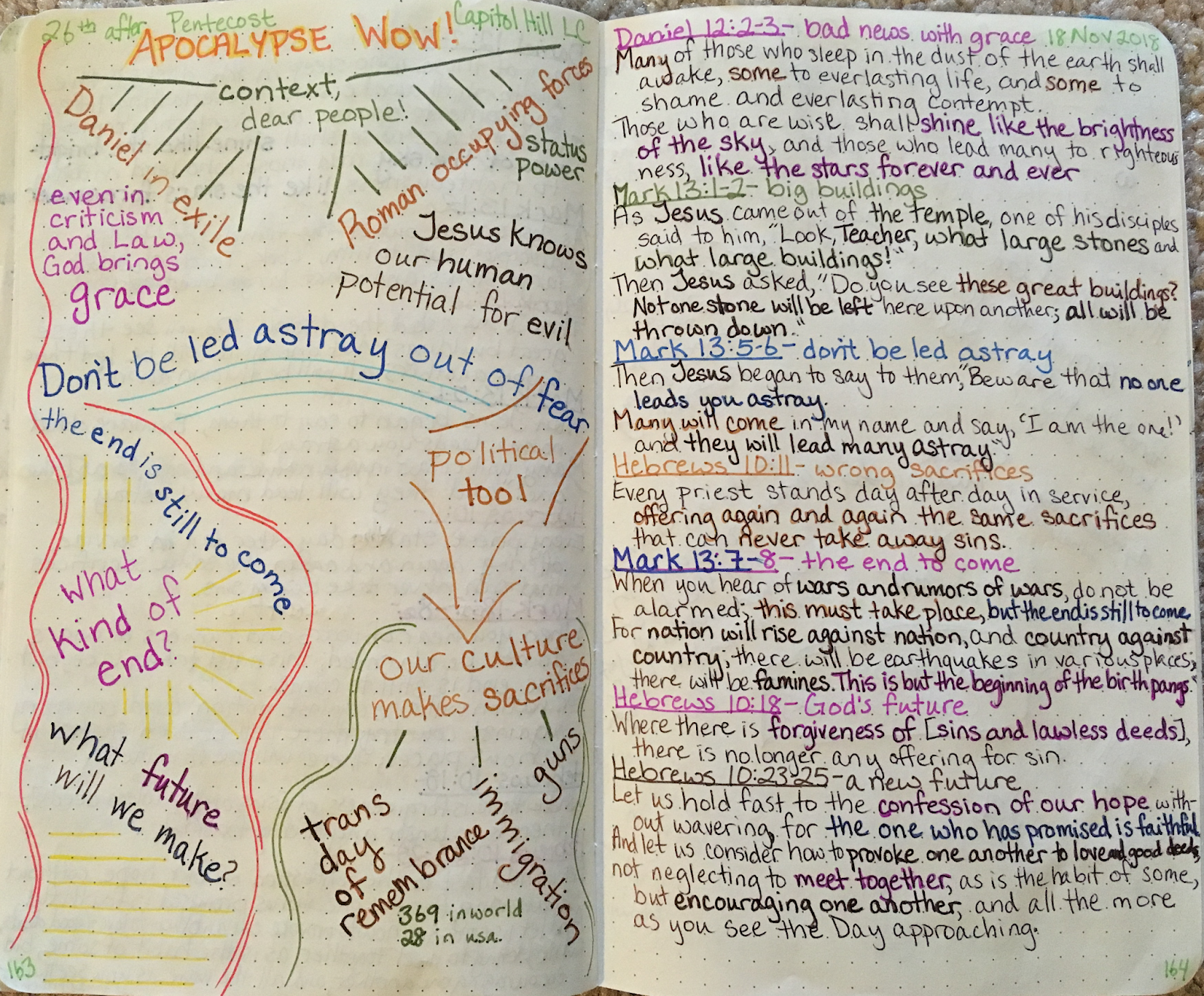
the end is still to come: 26th after pentecost year b

On November 18th, I preached and led worship at Capitol Hill Lutheran Church.  Rooted in my queerying of Mark, as well as my engagement with Daniel and Hebrews, this sermon dove deep into the context of the texts and our understanding of Apocalyptic literature in the bible as well as the reality of humanity's potential for evil.

We explored fear and the ways fear is used as a political tool to make our culture sacrifice people, specifically thinking of gun violence, violence against immigrants, and Transgender Day of Remembrance.  Acknowledging that the end is still to come, the possibilities of what kind of end we will join God in making ended the sermon.


This is the image I preached from for both worship services.

I can clearly tell how this sermon was connected to my queeries, but feel free to let me know if you need help with the connections or have any other comments or questions!


Sunday, October 21, 2018

Jesus liberates all people from power and oppression: 22nd after pentecost year b

One of the perks of doing pulpit supply in different contexts is that if an illustration works well two weeks in a row, I can use it both weeks.  This was one of those occasions.

The sermon was based on the gospel reading for today (plus the missing verses between last week and this week), using Archbishop and Saint, Oscar Romero, and the Catholic Church in El Salvador's story, including the acknowledging the u.s. role in the dictatorship that ultimately made a martyr of Saint Oscar. 

Additionally, Martin Luther's Freedom of a Christian connected well, reminding us that as followers of Christ we are simultaneously totally free subject to none and also servants of all.

I drew heavily on my queery for Mark.  If you have any questions about he connections to it, please let me know!

This is the image for my sermon.

I preached three different times over the course of my weekend and so the sermon itself grew and changed over time.  If you have any questions or insights, let me know!


Monday, October 15, 2018

jesus invites us into radical inversion: 21st after pentecost year b

This past weekend I preached at Capitol Hill Lutheran Church here in Des Moines.  While the sermon changed quite a bit from the first draft to the final, it remained rooted in my queerying of Mark 10:17-31.  I did record the sermon at one of the services, but don't have a way to host that much audio on my blog (but if you support me through ko-fi, I might be able to make it happen!).


This is the image I used for preaching.

In the gospel Jesus challenges a rich man who wants to know how to inherit eternal life and, in doing so, challenges notions of the Prosperity Gospel, inviting the man and all of us as Jesus' followers to a radical inversion of the way the world works.  As we celebrated Archbishop and Saint Oscar Romero's canonization, we also remembered the way God had worked that very inversion in Saint Romero in his lifetime.  If you'd like to know more about the sermon or connections to the queery, let me know!

Wednesday, October 03, 2018

Jesus gets serious about stumbling: 19th after pentecost b

This past weekend, I preached at a congregation I had never been to.  I drew heavily on both River Needham's queery of Numbers and my own queery of Mark to craft the sermon using my usual method.  The events of last week, especially the hearings for the Supreme Court justice, heavily informed my sermon.

Fun fact not included in my sermon: foot is frequently used in the bible to refer to genitalia,
so when Jesus says "If your foot causes you to stumble, cut it off..." you know what that means!

If you have any questions or want to know more about my sermon, let me know!

Sunday, September 23, 2018

Jesus changes the world's perspective: 18th after pentecost year b

I preached at Trinity las Americas today, a multilingual congregation that worships in Spanish and English and occasionally other languages (I got to read Proverbs in Slovak).  This is the manuscript I preached from, more or less how I preached it.

If you want to read the gospel in English, you can find it here.

Marcos 9:30-37
30Cuando se fueron de allí, pasaron por Galilea. Pero Jesús no quiso que nadie lo supiera, 31porque estaba enseñando a sus discípulos. Les decía:
—El Hijo del hombre va a ser entregado en manos de los hombres, y lo matarán; pero tres días después resucitará.
32Ellos no entendían lo que les decía, y tenían miedo de preguntarle.
33Llegaron a la ciudad de Capernaúm. Cuando ya estaban en casa, Jesús les preguntó:
—¿Qué venían discutiendo ustedes por el camino?
34Pero se quedaron callados, porque en el camino habían discutido quién de ellos era el más importante. 35Entonces Jesús se sentó, llamó a los doce y les dijo:
—Si alguien quiere ser el primero, deberá ser el último de todos, y servirlos a todos.
36Luego puso un niño en medio de ellos, y tomándolo en brazos les dijo:
37—El que recibe en mi nombre a un niño como éste, me recibe a mí; y el que me recibe a mí, no solamente a mí me recibe, sino también a aquel que me envió

El evangelio del Señor.

-----

Today’s gospel is full of misunderstanding. Jesus speaks of his future—a future of suffering and death before the resurrection—and the disciples don’t understand a single word! They don’t understand what Jesus says and then, they don’t even ask about it out of fear!  What are they afraid of if they don’t understand what Jesus is saying?  Or, is it that they’re afraid Jesus will tell them that they’re going to suffer and die also?

El evangelio para hoy está lleno de mal entendimiento.  Jesús habla de su futuro—un futuro de sufrimiento y muerte ante la resurrección—y los discípulos no entienden ni una palabra!  No entienden que dice Jesús y no le preguntan por el miedo!  De que tienen miedo si no entienden lo que Jesus esta diciendo?  O es que tienen miedo de que Jesus vaya a decirles que van a sufrir y morir también?

Como prueba de que no entienden, mientras que caminaran a Capernaúm, discutían sobre la pregunta de quien es lo más importante.  Es como si nunca fueran a entender a Jesus.  Entonces Jesús cambia su estrategia, dice que cualquier persona que quiere ser primera tiene que ser al servicio de todos.  Cualquier persona que reciba a niñas y niños, recibe a Jesús mismo.


Eso es una lección que muchos necesitan aprender hoy.

As proof that they don’t understand, while walking to Capernaum, the disciples discuss the question of who is the greatest among them! It’s as if they’re never going to understand Jesus. So Jesus changes his strategy, saying that whoever who wants to be first must be last of all and servant of all.  Whoever welcomes a child welcomes Jesus.

That is a lesson that many need to learn today.

While we are still separating children from their families at the border, discussing whether or not it is a sin to sexually assault another person, and lowering the numbers of refugees we will receive in this country, we cannot say that we receive Jesus.

Mientras todavía separamos niños de sus familias en la frontera, discutimos si es pecado o no abusar sexualmente de otra persona y bajamos los números de refugiados que recibiremos en este país, no podemos decir que recibimos a Jesús.

Muchas veces seguir a Jesús es muy complejo.  Pero en estos casos, no lo es.  Jesús dice: “reciba a niñas y niños y recibes a mi,” “si tu ojo, tu mano, cualquier cosa te hace caer en pecado, sácatelo” (Marcos 9:42-48) y “ama a tu prójimx—al extranjerx—a la gente más vulnerable—como a ti mismx.” (Marcos 12:28-34)

Sabemos el mandato, pero que ocurre aquí en Iowa? 

Many times following Jesus is very complex. But in these cases today, it is not. Jesus says: "Whoever welcomes one such child in my name welcomes me," "if your eye, your hand, anything causes you to stumble, cut it off" (Mark 9: 42-48) and "love your neighbor—the stranger—the most vulnerable people—as yourself.” (Mark 12:28-34)

We know Jesus’ call, but what do we do here in Iowa?

You all do it here at Trinity las Americas. You teach English classes, host a camp in the summers, support vulnerable people, work for justice. These activities are important. It’s important to say clearly that sexual violence is a sin on the part of the perpetrator and it’s important to tell that to elected representatives.


Uds. lo hacen aquí en Trinity las Americas.  Enseñan clases de ingles, hacen un campamento en los veranos, apoyan a gente vulnerable, trabajan por la justicia.  Estas actividades son importantes.  Es importante decir con claridad que la violencia sexual es pecado por parte del perpetrador y es importante decirle a los representativos elegidos. 

Hacemos el mundo en que vivimos y lo hacemos juntxs.  Jesús lo hizo por todo el mundo.  Vino a la tierra con todo el amor de Dios para estar con nosotrxs y para ser humano, para unir y amar todo el pueblo, todxs lxs oprimidxs. Jesús vino para cambiar como entendemos el mundo—que lo último viene primera y lxs primerxs ultimxs.
 

We make the world we live in and we do it together. Jesus did it for the whole world. He came to earth with all of the love of God to be with us and to be human, to unite and love all people, all the oppressed. Jesus came to change how we understand the world—that the last comes first and the first last.

As human beings, we responded to Jesus’ love with hatred and violence. The powers of this world thought that they won over the love of God in Jesus Christ, but they were wrong. They didn’t win against God—against the power and love of our God. As Jesus says, "The Son of Humanity is to be betrayed into human hands, and they will kill him, and three days after being killed, he will rise again."


Como seres humanos, respondimos al amor de Dios con odio y violencia.  Los poderes del mundo pensaron que hubieran ganado sobre el amor de Dios en Jesucristo, pero no.  No ganaron contra Dios—contra el poder y el amor de nuestro Dios.  Como dice Jesús, “El Hijo del hombre va a ser entregado en manos de los hombres, y lo matarán; pero tres días después resucitará.” 

La resurrección cambia a todo.  Hay muchos razones para tener miedo, pero también sabemos que Jesús vence a la muerte y los poderes del mal en el mundo para que podamos vivir y amar.


The resurrection changes everything.  There are plenty of reasons to be afraid, but we know that Jesus overcomes death and the powers of evil in the world so that we can live and love.

And in communion, Jesus unites us. Jesus gives his body, broken for every single one. We come with our bodies, broken by the powers, by the systems of injustice, by xenophobia, by racism, by biphobia, transphobia, sexism, and everything that does violence, everything that breaks us, and we are received by Jesus. Everything that harms us is left in those moments when we join together at the Table.

Y en comunión, Jesús nos une.  Le da su cuerpo, roto por todxs—todo el mundo.  Nosotrxs venimos con nuestros cuerpos, rotos por los poderes, por los sistemas de injusticia, por la xenofobia, por el racismo, por la bifobia, la transfobia, el sexismo, y todo que hace violencia, todo que nos rompe, y somos recibidos por Jesús.  Dejamos todo que nos hace daño por los momentos en que unimos en la Mesa. 

Nosotrxs, el cuerpo roto de Cristo, reunimos aquí para recibir el pan roto—el cuerpo de Cristo, dado por un mundo roto, para la restauración del mundo, para traer la justicia, la gracia, y el amor de Dios que ningún sistema, ningún poder puede quitarnos. 


We, the broken body of Christ, gather here to receive the bread broken—the body of Christ, given for a broken world, for the restoration of the world, to bring the justice, grace, and love of God that no system, no power can take away.

Jesus comes and changes everything with his love.


Jesús viene y cambia todo con su amor.

Gracias a Dios.


Thanks be to God.


Monday, April 16, 2018

Jesus' resurrection is for bodies: easter 3 year b


The holy gospel according to Luke. (24:36b-48)

[36While they were talking about this,]
Jesus Themself stood among the eleven and their companions and said to them,
     “Peace be with you.”
37The disciples were startled and terrified,
     and thought that they were seeing a ghost.
38Jesus said to them,
     “Why are you frightened,
     and why do doubts arise in your hearts?
          39Look at my hands and my feet;
               see that it is I myself.
                    Touch me and see;
                         for a ghost does not have flesh and bones 
                              as you see that I have.”
40And when Jesus had said this,
     They showed them Their hands and feet.
     41While in their joy those gathered were disbelieving and still wondering,
          Jesus said to them,
               “Have you anything here to eat?”
                    42They gave Jesus a piece of broiled fish,
                         43and Jesus took it and ate in their presence.
44Then Jesus said to them,
     “These are my words that I spoke to you while I was still with you—
          that everything written about me
               in the law of Moses, the prophets, and the psalms must be fulfilled.”
45Then Jesus opened their minds to understand the scriptures,
     46and said to them,
          “Thus it is written,
               that the Messiah is to suffer 
                    and to rise from the dead on the third day,
               47and that repentance and forgiveness of sins is to be proclaimed
                    in Their name to all nations,
                         beginning from Jerusalem.
          48You are witnesses of these things.”

The gospel of the Lord.

------

A couple weeks ago, Rev. Beth Wartick, a colleague in this synod, posted on Facebook, “Friends: the resurrection is for bodies.”  The post was a bit unsettling at first, because I think I’ve gotten pretty used to making the resurrection into an exclusively spirit and soul-centered or even an intellectual reality, I like to talk about it, but I’m less sure about its physicality. Our resurrection accounts both last week and this week, however, provide us with ample evidence for her statement.

Last week we encountered Jesus in the gospel of John presenting hands, feet, and side to the slow-to-believe and fear-filled disciples, prompting Thomas’ great declaration of faith, “My Lord and my God!”

Jesus’ presentation of Their actual resurrected body, wounds and all, speaks to the disciples in a way that no number of eye-witness accounts could have, and this week’s resurrection account is no different.

Jesus has just spent the day walking along the road to Emmaus with Cleopas and another disciple, explaining everything that Holy Week—Maundy Thursday, Good Friday, and that very Resurrection morning—meant.  Jesus had literally and figuratively walked them through all of scripture, interpreting it just for them.

But it wasn’t until Jesus sat with them and blessed and broke bread—the nourishment for their own bodies—that they recognized the Resurrected One.  And when Jesus shows up with the rest of the disciples in today’s reading, it is once again about the body: “39Look at my hands and my feet; see that it is I myself. Touch me and see; for a ghost does not have flesh and bones as you see that I have,” says Jesus.

Jesus knows the same truth as Pastor Beth: “The resurrection is for bodies.”  There is knowledge and wisdom in our bodies and embodied lives that our intellect can only ever grasp at futilely.  Jesus knows that our bodies carry in them the truths of our lived experiences, of our ancestors’ lives, and even the sparks of stardust that are scattered throughout the cosmos.

Each body comes from and is nourished by the dirt of the earth and is also made up of the stardust of that first Big Bang of life.  Each body reflects a piece of the image of God.  Jesus’ resurrection is about bodies because bodies matter to Jesus.  Bodies are part of our whole selves and when we create this false binary that divides souls from bodies, we fracture who we are.  We lose track of the fullness of our humanity and our belovedness by God.  We don’t just do this with words and ideas, we fracture the whole body of Christ, the image of God that we bear together, in physical ways as well.

Before moving to Iowa, I served as a pastor in rural southeastern Minnesota and I spent quite a bit of time with beloved children of God who worked on farms near town—not only those who owned or ran the farms, but especially those who make the oftentimes difficult and life-threatening trip north from Mexico and Central America to get up in the middle of the night to milk the cows, or early in the morning when it’s still below freezing to start harvesting the crops.

Their immigrant bodies, which carry so much of the burden and weight of feeding our country, are part of Jesus’ death and resurrection and Jesus loves them.

The bodies of those who cultivate the earth on farms, in personal or community gardens, and even in potted plants are also part of Jesus’ death and resurrection and Jesus loves them.

Your bodies, our bodies, weary from carrying us through decades of life, from backpacks full of school books, from the energy and demands of new babies and young children, or from the pressure to be or act a certain way are part of Jesus’ death and resurrection and Jesus loves them.

The bodies that struggle with stairs, standing, or even eating are part of Jesus’ death and resurrection and Jesus loves them.

The bodies of victims of violence, whether the violence happens in the confines of their home, at a party late at night, in the stares and fear of others on the street or at the coffee shop, across the world with chemical weapons and bombs in Syria, or anywhere in between are all part of Jesus’ death and resurrection and Jesus loves them.

The bodies of refugees, fleeing violence, seeking hope and compassion, allowed in some countries and not in others are part of Jesus’ death and resurrection and Jesus loves them.

The bodies around the world, in our fullest possible diversity—bodies that don’t look anything like yours and bodies that are so similar it isn’t possible to deny that you are kin—all of these bodies and your very own body are part of Jesus’ death and resurrection and Jesus loves them.

Bodies contain wisdom and understand truths that can be hard for us to grasp.  Jesus presents first a body with wounds—a broken, yet resurrected body—knowing that once the body understands the reality, the structure or skeleton, of the resurrection, then the words can give flesh to those bones.  Jesus’ words are good, but first Jesus’ body must convey the truth.

Jesus’ resurrection is bodily.  Jesus blesses and breaks bread.  Jesus eats broiled fish!  Jesus loves bodies.


“Friends: the resurrection is for bodies.

The resurrection is for: skinny bodies, fat bodies, in-between bodies.
The resurrection is for: brown bodies, black bodies, olive bodies, white bodies.
The resurrection is for: female bodies, transgender bodies, male bodies, tall bodies, short bodies.
The resurrection is for: undocumented bodies, citizen bodies, visitor bodies, immigrant bodies.
The resurrection is for: wrinkly bodies, smooth bodies, hairy bodies, swimsuit-ready bodies, sweatpants-ready bodies.
The resurrection is for: old bodies, young bodies, able bodies, disabled bodies, tired bodies.
The resurrection is for: any bodies, every body, your body.

Jesus loves your body enough to give it new life. Treat your body and your neighbor's body with the same respect you'd show to anything beloved by God.”
Amen.