Showing posts with label mark. Show all posts

Wednesday, November 21, 2018

the end is still to come: 26th after pentecost year b

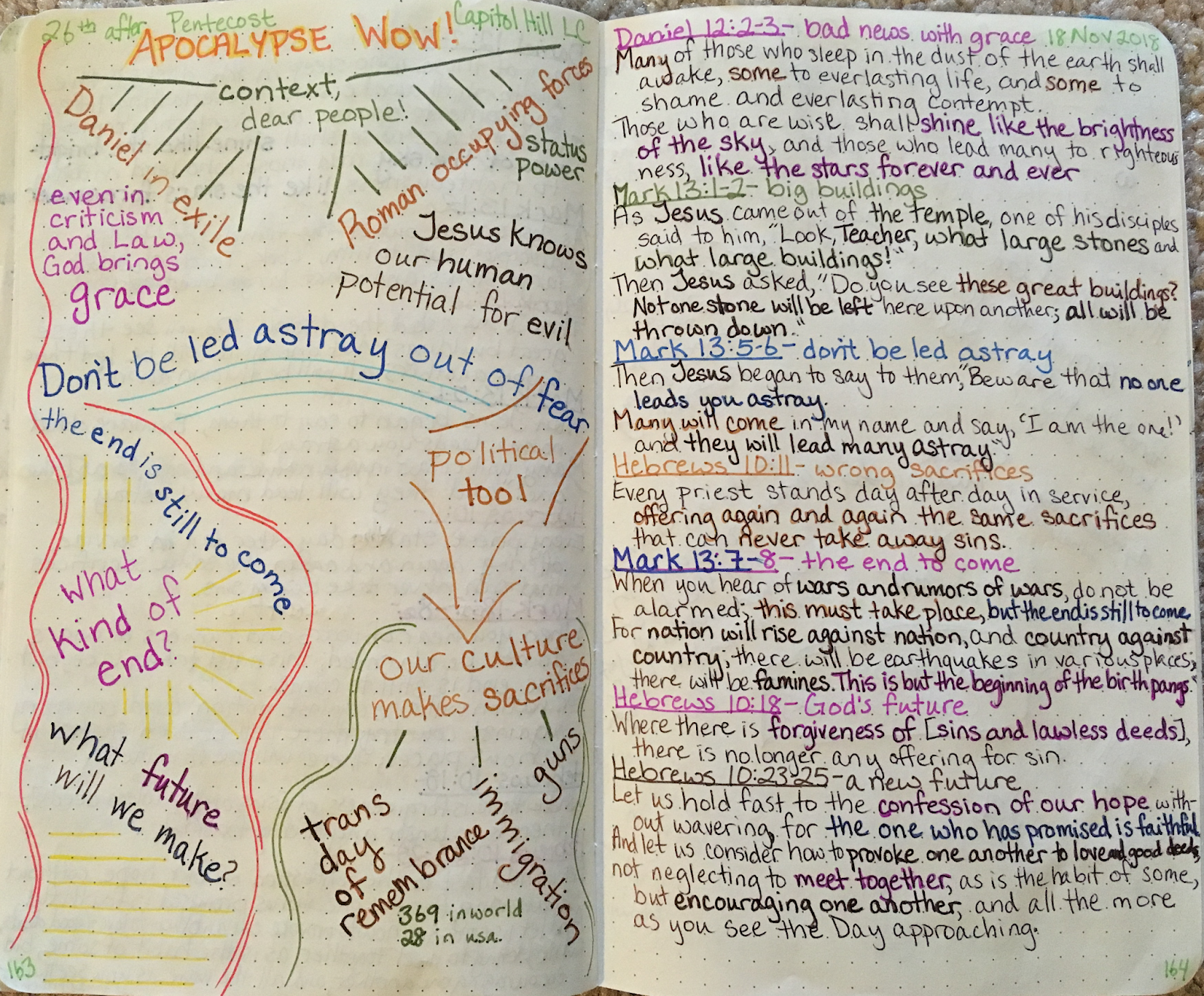
On November 18th, I preached and led worship at Capitol Hill Lutheran Church.  Rooted in my queerying of Mark, as well as my engagement with Daniel and Hebrews, this sermon dove deep into the context of the texts and our understanding of Apocalyptic literature in the bible as well as the reality of humanity's potential for evil.

We explored fear and the ways fear is used as a political tool to make our culture sacrifice people, specifically thinking of gun violence, violence against immigrants, and Transgender Day of Remembrance.  Acknowledging that the end is still to come, the possibilities of what kind of end we will join God in making ended the sermon.


This is the image I preached from for both worship services.

I can clearly tell how this sermon was connected to my queeries, but feel free to let me know if you need help with the connections or have any other comments or questions!


Sunday, October 21, 2018

Jesus liberates all people from power and oppression: 22nd after pentecost year b

One of the perks of doing pulpit supply in different contexts is that if an illustration works well two weeks in a row, I can use it both weeks.  This was one of those occasions.

The sermon was based on the gospel reading for today (plus the missing verses between last week and this week), using Archbishop and Saint, Oscar Romero, and the Catholic Church in El Salvador's story, including the acknowledging the u.s. role in the dictatorship that ultimately made a martyr of Saint Oscar. 

Additionally, Martin Luther's Freedom of a Christian connected well, reminding us that as followers of Christ we are simultaneously totally free subject to none and also servants of all.

I drew heavily on my queery for Mark.  If you have any questions about he connections to it, please let me know!

This is the image for my sermon.

I preached three different times over the course of my weekend and so the sermon itself grew and changed over time.  If you have any questions or insights, let me know!


Monday, October 15, 2018

jesus invites us into radical inversion: 21st after pentecost year b

This past weekend I preached at Capitol Hill Lutheran Church here in Des Moines.  While the sermon changed quite a bit from the first draft to the final, it remained rooted in my queerying of Mark 10:17-31.  I did record the sermon at one of the services, but don't have a way to host that much audio on my blog (but if you support me through ko-fi, I might be able to make it happen!).


This is the image I used for preaching.

In the gospel Jesus challenges a rich man who wants to know how to inherit eternal life and, in doing so, challenges notions of the Prosperity Gospel, inviting the man and all of us as Jesus' followers to a radical inversion of the way the world works.  As we celebrated Archbishop and Saint Oscar Romero's canonization, we also remembered the way God had worked that very inversion in Saint Romero in his lifetime.  If you'd like to know more about the sermon or connections to the queery, let me know!

Wednesday, October 03, 2018

Jesus gets serious about stumbling: 19th after pentecost b

This past weekend, I preached at a congregation I had never been to.  I drew heavily on both River Needham's queery of Numbers and my own queery of Mark to craft the sermon using my usual method.  The events of last week, especially the hearings for the Supreme Court justice, heavily informed my sermon.

Fun fact not included in my sermon: foot is frequently used in the bible to refer to genitalia,
so when Jesus says "If your foot causes you to stumble, cut it off..." you know what that means!

If you have any questions or want to know more about my sermon, let me know!

Sunday, September 23, 2018

Jesus changes the world's perspective: 18th after pentecost year b

I preached at Trinity las Americas today, a multilingual congregation that worships in Spanish and English and occasionally other languages (I got to read Proverbs in Slovak).  This is the manuscript I preached from, more or less how I preached it.

If you want to read the gospel in English, you can find it here.

Marcos 9:30-37
30Cuando se fueron de allí, pasaron por Galilea. Pero Jesús no quiso que nadie lo supiera, 31porque estaba enseñando a sus discípulos. Les decía:
—El Hijo del hombre va a ser entregado en manos de los hombres, y lo matarán; pero tres días después resucitará.
32Ellos no entendían lo que les decía, y tenían miedo de preguntarle.
33Llegaron a la ciudad de Capernaúm. Cuando ya estaban en casa, Jesús les preguntó:
—¿Qué venían discutiendo ustedes por el camino?
34Pero se quedaron callados, porque en el camino habían discutido quién de ellos era el más importante. 35Entonces Jesús se sentó, llamó a los doce y les dijo:
—Si alguien quiere ser el primero, deberá ser el último de todos, y servirlos a todos.
36Luego puso un niño en medio de ellos, y tomándolo en brazos les dijo:
37—El que recibe en mi nombre a un niño como éste, me recibe a mí; y el que me recibe a mí, no solamente a mí me recibe, sino también a aquel que me envió

El evangelio del Señor.

-----

Today’s gospel is full of misunderstanding. Jesus speaks of his future—a future of suffering and death before the resurrection—and the disciples don’t understand a single word! They don’t understand what Jesus says and then, they don’t even ask about it out of fear!  What are they afraid of if they don’t understand what Jesus is saying?  Or, is it that they’re afraid Jesus will tell them that they’re going to suffer and die also?

El evangelio para hoy está lleno de mal entendimiento.  Jesús habla de su futuro—un futuro de sufrimiento y muerte ante la resurrección—y los discípulos no entienden ni una palabra!  No entienden que dice Jesús y no le preguntan por el miedo!  De que tienen miedo si no entienden lo que Jesus esta diciendo?  O es que tienen miedo de que Jesus vaya a decirles que van a sufrir y morir también?

Como prueba de que no entienden, mientras que caminaran a Capernaúm, discutían sobre la pregunta de quien es lo más importante.  Es como si nunca fueran a entender a Jesus.  Entonces Jesús cambia su estrategia, dice que cualquier persona que quiere ser primera tiene que ser al servicio de todos.  Cualquier persona que reciba a niñas y niños, recibe a Jesús mismo.


Eso es una lección que muchos necesitan aprender hoy.

As proof that they don’t understand, while walking to Capernaum, the disciples discuss the question of who is the greatest among them! It’s as if they’re never going to understand Jesus. So Jesus changes his strategy, saying that whoever who wants to be first must be last of all and servant of all.  Whoever welcomes a child welcomes Jesus.

That is a lesson that many need to learn today.

While we are still separating children from their families at the border, discussing whether or not it is a sin to sexually assault another person, and lowering the numbers of refugees we will receive in this country, we cannot say that we receive Jesus.

Mientras todavía separamos niños de sus familias en la frontera, discutimos si es pecado o no abusar sexualmente de otra persona y bajamos los números de refugiados que recibiremos en este país, no podemos decir que recibimos a Jesús.

Muchas veces seguir a Jesús es muy complejo.  Pero en estos casos, no lo es.  Jesús dice: “reciba a niñas y niños y recibes a mi,” “si tu ojo, tu mano, cualquier cosa te hace caer en pecado, sácatelo” (Marcos 9:42-48) y “ama a tu prójimx—al extranjerx—a la gente más vulnerable—como a ti mismx.” (Marcos 12:28-34)

Sabemos el mandato, pero que ocurre aquí en Iowa? 

Many times following Jesus is very complex. But in these cases today, it is not. Jesus says: "Whoever welcomes one such child in my name welcomes me," "if your eye, your hand, anything causes you to stumble, cut it off" (Mark 9: 42-48) and "love your neighbor—the stranger—the most vulnerable people—as yourself.” (Mark 12:28-34)

We know Jesus’ call, but what do we do here in Iowa?

You all do it here at Trinity las Americas. You teach English classes, host a camp in the summers, support vulnerable people, work for justice. These activities are important. It’s important to say clearly that sexual violence is a sin on the part of the perpetrator and it’s important to tell that to elected representatives.


Uds. lo hacen aquí en Trinity las Americas.  Enseñan clases de ingles, hacen un campamento en los veranos, apoyan a gente vulnerable, trabajan por la justicia.  Estas actividades son importantes.  Es importante decir con claridad que la violencia sexual es pecado por parte del perpetrador y es importante decirle a los representativos elegidos. 

Hacemos el mundo en que vivimos y lo hacemos juntxs.  Jesús lo hizo por todo el mundo.  Vino a la tierra con todo el amor de Dios para estar con nosotrxs y para ser humano, para unir y amar todo el pueblo, todxs lxs oprimidxs. Jesús vino para cambiar como entendemos el mundo—que lo último viene primera y lxs primerxs ultimxs.
 

We make the world we live in and we do it together. Jesus did it for the whole world. He came to earth with all of the love of God to be with us and to be human, to unite and love all people, all the oppressed. Jesus came to change how we understand the world—that the last comes first and the first last.

As human beings, we responded to Jesus’ love with hatred and violence. The powers of this world thought that they won over the love of God in Jesus Christ, but they were wrong. They didn’t win against God—against the power and love of our God. As Jesus says, "The Son of Humanity is to be betrayed into human hands, and they will kill him, and three days after being killed, he will rise again."


Como seres humanos, respondimos al amor de Dios con odio y violencia.  Los poderes del mundo pensaron que hubieran ganado sobre el amor de Dios en Jesucristo, pero no.  No ganaron contra Dios—contra el poder y el amor de nuestro Dios.  Como dice Jesús, “El Hijo del hombre va a ser entregado en manos de los hombres, y lo matarán; pero tres días después resucitará.” 

La resurrección cambia a todo.  Hay muchos razones para tener miedo, pero también sabemos que Jesús vence a la muerte y los poderes del mal en el mundo para que podamos vivir y amar.


The resurrection changes everything.  There are plenty of reasons to be afraid, but we know that Jesus overcomes death and the powers of evil in the world so that we can live and love.

And in communion, Jesus unites us. Jesus gives his body, broken for every single one. We come with our bodies, broken by the powers, by the systems of injustice, by xenophobia, by racism, by biphobia, transphobia, sexism, and everything that does violence, everything that breaks us, and we are received by Jesus. Everything that harms us is left in those moments when we join together at the Table.

Y en comunión, Jesús nos une.  Le da su cuerpo, roto por todxs—todo el mundo.  Nosotrxs venimos con nuestros cuerpos, rotos por los poderes, por los sistemas de injusticia, por la xenofobia, por el racismo, por la bifobia, la transfobia, el sexismo, y todo que hace violencia, todo que nos rompe, y somos recibidos por Jesús.  Dejamos todo que nos hace daño por los momentos en que unimos en la Mesa. 

Nosotrxs, el cuerpo roto de Cristo, reunimos aquí para recibir el pan roto—el cuerpo de Cristo, dado por un mundo roto, para la restauración del mundo, para traer la justicia, la gracia, y el amor de Dios que ningún sistema, ningún poder puede quitarnos. 


We, the broken body of Christ, gather here to receive the bread broken—the body of Christ, given for a broken world, for the restoration of the world, to bring the justice, grace, and love of God that no system, no power can take away.

Jesus comes and changes everything with his love.


Jesús viene y cambia todo con su amor.

Gracias a Dios.


Thanks be to God.


Tuesday, November 28, 2017

advent 1 year b

This series has now moved over to my other blog: https://christianityisaqueerthing.blogspot.com/

Mark 13:24-37

24“But in those days, 
     after that suffering,
          the sun will be darkened,
          and the moon will not give its light,
          25and the stars will be falling from heaven,
          and the powers in the heavens will be shaken.
 

     26Then they will see ‘the Human One coming in clouds’ 
          with great power and glory. 
     27Then the One will send out the angels, 
          and gather the elect from the four winds, 
               from the ends of the earth to the ends of heaven.


28“From the fig tree learn its lesson: 
     as soon as its branch becomes tender and puts forth its leaves, 
          you know that summer is near. 
     29So also, when you see these things taking place, 
          you know that the One is near, 
               at the very gates. 
     30Truly I tell you, 
          this generation will not pass away 
               until all these things have taken place. 
          31Heaven and earth will pass away, 
               but my words will not pass away.

32“But about that day or hour no one knows, 
     neither the angels in heaven, 
     nor the Child, 
          but only the Parent. 
33Beware, keep alert; 
     for you do not know when the time will come. 
34It is like a person going on a journey, 
     when they leave home 
     and put their slaves in charge, 
          each with their work, 
     and command the doorkeeper to be on the watch. 
          35Therefore, keep awake—
               for you do not know when the master of the house will come, 
                    in the evening, 
                    or at midnight, 
                    or at cockcrow, 
                    or at dawn, 
                         36or else the master may find you asleep 
                              when they come suddenly. 
               37And what I say to you I say to all: 
                    Keep awake.”

Queeries for the text:
Is darkness a trait of the Human One?  And of great power and glory?
Is darkness good?
Is tenderness a sign of the coming of the Human One?
Will the Human One be undocumented?
Who is the master?
Is being exhausted but awake better than being woken up in the middle of sleep?
Does this poetry speak deep into anyone else's soul?
What does it mean to "pass away"?
Do the elect from the four winds come from the four directions?

Sunday, October 15, 2017

YAGM Wilderness


This is the manuscript that I preached from for the opening worship at this year's YAGM Re-Entry Retreat.

A reading from Mark (1:9-13).

9In those days Jesus came from Nazareth of Galilee
      and was baptized by John in the Jordan.
      10And just as Jesus was coming up out of the water,
            he saw the heavens torn apart
            and the Spirit descending like a dove on him.
      11And a voice came from heaven,
            “You are my Child,
                  the Beloved;
                        with you I am well pleased.”
      12And the Spirit immediately drove Jesus out into the wilderness.
            13He was in the wilderness forty days,
                  tempted by Satan;
            and he was with the wild beasts;
            and the angels waited on him.

Word of God, Word of Life.  Thanks be to God.

-----

I grew up in the mountains of Colorado, so I have always loved the Bible passages about the wilderness.  It’s easy to imagine the wilderness, because it was my back yard growing up.  And it’s beautiful and fun—the snow, the aspen leaves in fall, the bluest of blue skies.  I have always had a fondness for the wilderness.

Then, as I was getting ready to graduate from Luther College, I came here for DIP.  From there, I ended up in a different kind of wilderness in a small village in eastern Slovakia.  Sure, there are hills and even a few mountains in Slovakia, and I got to go hiking and enjoy nature, but this was a different kind of wilderness.

Like the wilderness we find throughout the Bible, this wilderness wasn’t familiar to me and it wasn’t always friendly.  You all have spent a year in the wilderness.  And in that year, a lot has changed.  You have changed.  The people who sent you have changed.  The people you encountered have changed.  This country has changed.  That’s what wilderness does.  It changes you.

Whether you’ve heard the distant rumbles of the heavens being torn apart or encountered wild beasts, doves, or angels—or maybe all of them at once.  You spent a year away from your family, your friends, your loved ones, and that is hard.  I can’t help but think of the words from the song, The Summons, “Will you go where you don’t know and never be the same?”        

You did.  And you probably will again.  And it will still be hard.               It is hard to be different and an outsider.  I still remember those first months in Slovakia, hearing sermons and Bible studies in which I could only pick out a few of the words.  And the sinking feeling I would get in my stomach every time the word I understood was Sodom or Gomorrah, knowing that there was a part of me as a queer person that would never belong.

Maybe for you it was a racist remark, or the violence you witnessed in words or actions, the access your u.s. passport granted you at checkpoints, the parts of the language that always eluded you, or the customs that never quite got explained so that you could understand and participate.

The wilderness doesn’t always make sense, and sometimes it hurts; but the other thing about the wilderness is that that’s where Jesus goes.  Jesus is baptized by John in the Jordan, the heavens are torn apart, God claims Jesus as beloved, and then “the Spirit immediately [drives] Jesus out into the wilderness,” to you.

Because that is what YAGM is about: Jesus finding you—in the hug of your host mom on that extra homesick kind of day, in the kids who are excited about how well they did on the test—or who continue to push your buttons until the day you leave; in the struggles to understand yourself and others, in the quiet moments of just being with another person, drinking mate, talking, singing, laughing, and crying.

We as the church have sent you out into the wilderness and called you back to a new kind of wilderness in this country.  This wilderness is both familiar and foreign, full of love and full of fear and hatred.  The struggles against injustice, the pain of oppression, sorrow, and hardship are not reserved for other countries. They are here, too, as are countless options for which spaghetti sauce or laundry detergent to buy, new and different ways to ride the bus—no longer the crammed rush hour buses of Buenos Aires or the long winding country roads. 

But what may be the hardest about this new wilderness we’ve called you back to is that it seems so much like the land and places and people you called home before; like a place you should know.  Shouldn’t you understand what to do, who and how to be here?  And shouldn’t they understand you?   

But the people, the places, the politics here        have all changed in subtle and obvious ways,                  as have you, so that the ways you seek familiarity and comfort aren’t the same.  The people you are encountering again might not understand why you like different foods, why you need more time to talk or more time to be silent, but together, than you did before. It's wild, this new wilderness.

Your YAGM year may have ended, but this journey in the wilderness has not, and maybe it never will.  Maybe, as you continue to leave your heart in different places, you will always find a wilderness around you—of joyful mountains and snow, of desert and scorching heat, of safety and of danger.  We don’t know.  You can’t know until you get there.

But the promise I have, the promise of God for you, is that Jesus will show up.  In the suffering and struggle as well as the comfort and joy.  Jesus will show up because that’s how the Holy Spirit works—in the most unexpected places and ways—driving Jesus out into the wilderness to meet you.

The Holy Spirit has claimed you.  The voice from heaven claims Jesus and she claims you as well.

You are God’s child, the Beloved, with whom God is well pleased.  And there is no amount of wilderness or struggle or pain or screw up that can make that untrue.  There is no loneliness, isolation, alienation, or oppression that diminishes God’s immense love for you.  And, especially in these days that we have together, there is no questioning, frustration, random burst of laughter or tears, or befuddlement that is more powerful than God’s love for you.  No matter what.

Thanks be to God.

Sunday, June 21, 2015

Jesus calls us through the storm to the other side: 4th after pentecost


The first reading, which I also relied on, is Job 38:1-11.

The holy gospel according to Mark (4:35-41).

35On that day,
       when evening had come,
              Jesus said to the disciples,
                     “Let us go across to the other side.”
              36And leaving the crowd behind,
                     they took him with them in the boat,
                            just as he was.
                                   Other boats were with him.

37A great windstorm arose,
       and the waves beat into the boat,
              so that the boat was already being swamped.
                     38But Jesus was in the stern,
                            asleep on the cushion;
                     and they woke him up and said to him,
                            Teacher, do you not care that we are perishing?”
                     39Jesus woke up and rebuked the wind,
                            and said to the sea,
                                   “Peace! Be still!”
                            Then the wind ceased,
                                   and there was a dead calm.
                     40He said to them,
                            “Why are you afraid?
                                   Have you still no faith?”

41And they were filled with great awe
       and said to one another,
              “Who then is this,
                     that even the wind and the sea obey him?”

The gospel of the lord.

-----

On Monday and Tuesday, and even Wednesday as I worked on and planned for my sermon, I wanted to talk about the storm we are in as a community of faith.  The storm of emotions inside us, the storm of uncertainty about what is on the other side of August 31st, of closure.  I could still do this, and we could have a sermon on that, and it would be important and meaningful, and it would be easier than tackling what has been going on this week.

Sharonda Coleman-Singleton, 45 years old, was a beloved track coach and a minister at Emanuel African Methodist Episcopal Church. Clementa Pinckney, 41 years old, was the lead pastor at the AME church, a state senator, and a graduate of one of our ELCA seminaries. Cynthia Hurd, 54 years old, was a librarian, whose birthday would have been today (Sunday). Tywanza Sanders, 26 years old, was a recent graduate of Allen University’s Division of Business Administration, and he died trying to shield his 87-year-old aunt from the shooter.

Myra Thompson, 59 years old, was reverend Anthony Thompson’s wife, Ethel Lee Lance, 70 years old, was the church sexton, Daniel L. Simmons, 74 years old, was a ministerial staff member, a father and a grandfather and a veteran of war. Depaynoe Middleton-Doctor, 49 years old, sang in the choir and preached at her church. Susie Jackon, 87 years old, sheltered young people who needed a place to live after her son moved away from home. 

The wind and storm that rages around us here in this community as we struggle with the reality of Christ the King’s closure can block from view all that is happening in the world.  In light of our anxiety and sorrow at leaving this faith community, the struggle we have with the God who is in the whirlwind, what does anything else matter?

And yet this week I spent time with church leaders from around the country—siblings in the ELCA and siblings in Christ.  While we were together, talking about the church, our struggles, what it’s like to be women and men, racially diverse in the church and the country, a white ELCA Lutheran man went into a historically black church, engaged with the people gathered in Bible study, and then opened fire, as he murdered 9 beloved children of God.

Welcomed into the body of Christ at Mother Emmanuel African Methodist Episcopal Church, he created a storm around his fellow followers of Christ.  I could not help but remember the four girls killed in Birmingham, Alabama during the Civil Rights movement when a bomb went off in their church.  This is not the first time that African Americans have asked Jesus, “Do you not care that we are perishing?”  And this is not the first time even in the last year, that they have asked us as well.  What we must ask ourselves, then, is: in the midst of our storms and worries, do we not care that they are perishing?

Jesus calms the storm that threatens the disciples’ lives and yet the storm of racism, as evidenced by the hate crime of this week, continues to rage on.

As I think about that white man who entered and was welcomed into community by those he would later murder, I can’t help remember the privilege I have had in my life to be welcomed into Black congregations, Latin@ congregations, as well as white ones.  Communities that constantly battle against racism have often been the most warmly welcoming to me. 

This week I could lift Emanuel AME up in our prayers and continue with the sermon I wanted to preach, but that betrays the trust and hospitality I have received in my life from people of color.  It is also a mark of privilege that African American pastors and preachers who are also facing the kinds of storms we are do not have.  They cannot lift Emanuel AME up in their prayers and keep on the way they were, because their congregations are receiving bomb threats, their sanctuary has been violated, their people are being killed by the sin of racism.

And it’s not just their people.  It’s our people.  A member of our church body committed that terrorist attack and graduates of one of our ELCA seminaries were killed.  Siblings in Christ were on both sides.  Fellow humans are dead today.  Grief and sorrow, suffering and anger.  Our people are hurting.  Our siblings in Christ.  Our fellow humans.

Charleston, South Carolina may feel far away, but it is only the most recent, most evident example of the devastation that racism causes in our country.  It happens here in Utah as well.  We know what it is like here to not be part of the dominant culture.  We know the exclusion, especially that of our children, who are left out at school because of who they are—or rather, who they aren’t. 

Even so, we have the benefit of visibly fitting in—of looking like the dominant culture, of being judged positively by the color of our skin. 

And yet even here, children of God like Darien Hunt are killed and children of God are told they are not worth as much because of who they are, the color of their skin.  All the while, many of us are not willing to cross to the other side for fear of the storm.   Many of us are scared of the water that will crash over the side of the boat, the whirlwind that swirls around, the lack of control that comes with boats and storms, and comes with deep caring and pain. 

It can be scary and it is hard to know what to do in the storm, what we will encounter on the other side, but that is where Jesus goes.  Jesus is in the storm, Jesus is in the storm of racism that rages around us, Jesus is with those who ask “Do you not care that we are perishing?”  Jesus leads us to the other side—through the storm, Jesus calls us into engagement on the other side.  Jesus is unperturbed by the storm we think will do us in.

Jesus knows the way.  He knows that there are demons waiting.  He also knows that those demons will remain if we don’t cross to the other side.  What does that look like?  How do we as individuals tackle the monsters of terror?  How do we tackle racism?  What can we possibly do? 

We are not alone.  We are not in this fight alone.  People of color have been fighting this fight their whole lives.  As we engage in the struggle against racism, we journey with each other.  We journey with congregations across Utah and across the country. 

There are steps we can take. 

This week, try to listen and read only news and information about the domestic terrorism attack on Emanuel AME from Black people.  Listen to them.  Read their words.  And believe them.  Too often we encounter white people talking about people of color.  Or when people of color do speak, we dismiss them and their very real emotions.  Resist this.  Listen to people of color.  Read their words.  Believe them.

Focus not on the terrorist who attacked, but on those who were killed, the community of Emanuel AME Church—Mother Emanuel as it is called.  Honor them by learning about their lives and their faith community.  Support their congregation financially as well as in prayer. 

Learn about privilege and racism.  There are articles and books that open space for understanding, like Unpacking the Invisible Knapsack by Peggy McIntosh.  I know some more and am happy to recommend them. 

Jesus calls us to follow him.  We don’t have to know the whole way.  We don’t have to know what awaits us on the other side.  We don’t even have to be excited or calm or confident.  We just follow.  Get in the boat, and see where Jesus leads.  It won’t be easy.  He ended up on the cross, after all. 

But our God is a God who brings life out of death.  If the life that he brings out of this week’s deaths is awareness of the pain of racism, the impact of the color of our skin on us, a commitment to learn more, to care more, to avoid the pain a little less.  If God brings this life out of these deaths, then God is good.  All the time. 
Sunday, June 14, 2015

God makes seeds grow: 3rd after pentecost

Notes for understanding: this past week Rocky Mountain Synod's Council voted to close the minsitry of Christ the King, where I serve as Pastor and Mission Developer, effective August 31st.  The congregation found out on Thursday, so this was our first time together since finding out the news.  Here is my sermon manuscript, which I mostly followed.

The other reading I refer to is 2 Corinthians 5:6-17.

The holy gospel according to Mark (4:26-34)

26Jesus said,
       “The dominion of God is as if someone would scatter seed on the ground,
              27and would sleep and rise night and day,
                     and the seed would sprout and grow,
                            the sower does not know how.
              28The earth produces of itself,
                     first the stalk,
                            then the head,
                                   then the full grain in the head.
                                          29But when the grain is ripe,
                                                 at once the sower goes in with a sickle,
                                                        because the harvest has come.”

30Jesus also said,
       “With what can we compare the dominion of God,
              or what parable will we use for it?
                     31It is like a mustard seed,
                            which, when sown upon the ground,
                                   is the smallest of all the seeds on earth;
                            32yet when it is sown
                                   it grows up
                                   and becomes the greatest of all shrubs,
                                   and puts forth large branches,
                                          so that the birds of the air can make nests in its shade.”

33With many such parables Jesus spoke the word to them,
       as they were able to hear it;
              34he did not speak to them except in parables,
                     but he explained everything in private to his disciples.

The gospel of the Lord.

-----

Today of all days and this week of all weeks, it would be easy for us to hear Jesus’ words about the dominion of God and scoff.  Everything does not seem new.  Seeds have been planted here in this community for more than 8 years.

We had hoped those seeds would sprout and grow into an organized congregation of the Evangelical Lutheran Church in America, and yet we come to hear the news and discern what it will look like to close this expression of the ELCA here in South Jordan.

It would, perhaps, also be easy to say that our planting failed—that we have failed.  But that would be, as Paul says in his letter to the Corinthians, regarding things “from a human point of view.”  This community of faith has failed if our only metrics are how many butts we got in chairs in worship and our inability to financially sustain the whole ministry.

Those are not God’s metrics.  God’s measurements deal with more important things: how many people’s lives are different because we have existed in this place?  We’re not just talking about how many people have worshiped here over the years, but how many children in crisis were comforted by our Project Linus blankets?  How many faith lives were challenged and strengthened by receiving God’s grace through baptism and Holy Communion? 

How many people had a little more to eat because of our food bank donations and ELCA World Hunger collections?  How many Native American Elders have toothbrushes and toothpastes, children have books, and kids dealing with grief have snacks because of our Lenten efforts?

How many people are still on the path to recovery because we have made space for Alcoholics Anonymous and Food Addicts in Recovery Anonymous?  How many more children of God know that God loves them and that there are communities of faith that care about them, because of our presence with other communities of faith in the Pride Parade last weekend?

While Christ the King will come to an end, many of the seeds that have been planted are still in the ground.  “The earth produces of itself” and you continue to be a follower of Christ in the world.   

Your engagement with the Bible, the prayers you lift up each week, your faith expressed in the ways you care for neighbors; these ways God continues to work to make God’s love and grace known through you are not only fruits of the seeds planted already, but they also plant more seeds.   

And so even while the body of Christ gathered here may change and go our different ways, the dominion of God continues to spread like the mustard seed—greatest of all shrubs, and a weed that takes over wherever it is planted.

What is our task in the coming weeks and months?  How will we as a community of faith bear witness to the God of death and resurrection?  How do we continue to sow the seeds of faith in and with each other?  To nourish them in the time we have together?

What if we really take the time and spend our energy in the next couple of months watering the seeds that have been planted, making sure they are in good soil, not rocky?  What if we focus on nurturing this community?   

What if we focus on even something as simple as prayer?  What if we took this time to really pray for the church, the whole cosmos, and all those in need?  If we took our prayer list with us throughout the week and prayed at stoplights, in grocery store lines, or even doodling our prayers at home before bed or before breakfast?

In our Sunday evening worship we’ve been praying through origami by writing prayers on pieces of origami paper and then I usually fold them into cranes, praying with the one who wrote the prayer.  In Japan, there is a legend that if anyone folds 1000 paper cranes they can be healed, or have luck forever, or their wish will be granted.

What if we made 1000 paper cranes of prayers for the healing and wholeness of all of God’s creation?  It would be a mustard seed of the dominion of God.  Each paper crane prayer might not seem like much, but like a mustard seed, our prayers—the time we spend intentionally with God is not time wasted.  It grows in us and it grows in the world like a weed.  Spreading to take over more than we can even know or imagine.

How will God continue to nourish the seeds we’ve planted over the years?  How will God nourish the ones we plant this summer?  “The sower does not know how.”  It is not for us to know or say, but to trust God on this journey of faith, as we have so many times before.  Because God does nourish and grow the seeds of faith in us and in others, always.

Thanks be to God.

Sunday, April 05, 2015

easter sunday


The first reading is from Isaiah 25:6-9.
The second reading is from Acts 10:34-43.

The holy gospel according to Mark (16:1-8).

When the sabbath was over,
       Mary Magdalene, and Mary the mother of James, and Salome bought spices,
              so that they might go and anoint Jesus.
              2And very early on the first day of the week,
                     when the sun had risen,
                            they went to the tomb.
                     3They had been saying to one another,
                            “Who will roll away the stone for us 
                                   from the entrance to the tomb?”
                                   4When they looked up,
                                          they saw that the stone,
                                                 which was very large,
                                                        had already been rolled back.
                     5As they entered the tomb,
                            they saw a youth,
                                   dressed in a white robe,
                                   sitting on the right side;
                                          and they were alarmed.
                            6But the youth said to them,
                                   “Do not be alarmed;
                                          you are looking for Jesus of Nazareth,
                                                 who was crucified.
                                          He has been raised;
                                                 he is not here.
                                                        Look, there is the place they laid him.
                                   7But go,
                                          tell his disciples and Peter
                                                 that he is going ahead of you to Galilee;
                                                 there you will see him,
                                                        just as he told you.”
                     8So they went out and fled from the tomb,
                            for terror and amazement had seized them;
                                   and they said nothing to anyone,
                                          for they were afraid.

The gospel of the Lord.

-----

Alleluia!  Christ is risen!  -- Christ is risen indeed!  Alleluia!

Today is our day of celebration!  The greatest day—the Highest Holy Day of the church year.  The battle is over, the victory won—or so the old hymn goes.  Today is a day to celebrate and give thanks—and we are doing just that!  Our alleluias have returned, our decorations are in full splendor—even our liturgy is new as we give thanks for our baptism and return to our hymn of praise.  Easter is here!

And yet…the world is not perfect.  It is not all Easter lilies, sunshine, eggs and bunnies.  God’s love is for everybody, but not everyone knows that God loves them as they are.  People are still sick, suffering, neglected, and alone. 

This is the crux of Christianity.  We are people of the resurrection—Easter people living in a Good Friday world.  Even as we rejoice in the resurrection, our risen lord bears the marks of his execution.  Jesus’ followers come to the tomb in the midst of their mourning, seeking some consolation and perhaps even closure on the death of the man they have been following.  And what they find is anything but that.  They encounter a youth who tells them that “Jesus of Nazareth who was crucified…has been raised”

Into the midst of their sorrow and pain this stranger breaks in with news that doesn’t make sense.  They come to the tomb looking for, expecting, death.  They expect to find a body broken by the world, executed, crucified.  The world around them is in shambles and yet they find this youth, telling them that it’s not the end? 

The tomb around them echoes of the cries of Good Friday; the space feels so forgotten and so alone, reverberating its desolation around them.  Or is it another sound reverberating.  Are those the cries of crucify him or are they the beginning chirps of the birds, the start of hesitant alleluias?  The dull morning grays that have been covering their world and have accompanied them to the tomb begin to give way to the bright colors of morning.  The world taking shape around them is a different world, a different shape than the one they were expecting.  And the women, squinting in the light, hear “Jesus has been raised; he is not here.

How is this new life possible?  Just days ago everyone was scattering, afraid for their lives and the women watched, weeping as Jesus hung on that tree.  The one who was supposed to save them all, dying, even as darkness covered the earth and the Roman centurion confessed that “truly this man was God’s son” (Mark 15:39).  Yet the world is shattered, as if the floor has fallen out from under us.  This agony and pain at seeing Jesus on the cross must be the bottom, we can’t possibly fall any further.  All hope is lost.  What is left to do, but to anoint the body that by now must be long-dead?  We go to say our final goodbyes, to give up our last ounce of hope.

And then—the tomb is empty!  Jesus is gone?!  And this youth thinks Jesus is risen?!

Go, share this good news?  I don’t think so!  High-tail it out of there in terror and amazement, saying “nothing to anyone for they were afraid”?  Sounds like a good plan!  I’m in.  The empty tomb is never expected.  The tomb is always supposed to be there, full of death and sorrow.  What place does an empty tomb have in this world?  What nerve to bring resurrection and new life into the midst of our sorrow and pain!  How could this be?

Terror and amazement are powerful things.  God calls us into this new life—this resurrection promise, even as the world around us, ourselves included, is still reeling from Good Friday.  New life in the midst of death?  New hope for a life I don’t yet know is terrifying, even when the alternative is a deathly life I do know.  Are we really supposed to drop everything and just believe?  Just trust?

If Jesus’ followers are any indicator, then no.  Throughout Mark, Jesus’ followers have been messing up, misunderstanding, and losing faith—losing courage.  They have misguided and rebuked, denied and betrayed both Jesus and others.  But maybe it’s not their fault.  It’s not like they sought Jesus out.  They were minding their own business.  Fishing, living life, and he came to them.  Jesus searched and found them!  He called them by name and claimed them!

And even with all their mess ups and missteps, their inaction from terror and amazement, Jesus comes to them.  Jesus keeps coming back.  He even comes back from the grave to meet them in Galilee!  He goes to rock bottom, diving down to the deepest depths, deeper than we ever thought our rock bottom could be, and joins us. 

Jesus comes to our rock bottoms, comes to be with us.  And even as we go “out and flea from the tomb, for terror and amazement have seized us; and we say nothing to anyone, for we are afraid,” Jesus meets us where we’re going. 

The movie The Salt of the Earth is about a Mexican American mineworkers strike in New Mexico. In a fight with her husband, who is a striking worker, the protagonist, Esperanza, says that Ramón wants to improve his own life so he can have someone under him to boss around, so that he can feel superior. But Esperanza says, “I don't want anything lower than I am. I'm low enough already. I want to rise. And push everything up with me as I go."

Jesus comes to rock bottom to be with us, but not to leave us there.  Jesus is in the business of pushing everyone up.  Jesus comes to rock bottom so that he can push up to new life with everyone.  Jesus comes today with signs of new life from our decorations and lilies to the signs of new life and new people in our community of faith (to the new life of community organizations caring for those in need in our community). 

Jesus is always coming to us, whether we recognize it or not, whether we’re ready or not, whether our reaction is terror, amazement, both or something else entirely.  Jesus comes to us, Jesus sits with us, and Jesus waits for us.  The Persistent One is ever patient with our terror and amazement.  Sitting with our complex emotions, our fear and doubt and our joy and laughter.

No matter what is going on with us, Jesus brings new life, new chances, pushing up with everyone and everything that he has.  He comes with second, third, even hundredth chances!  Why?  Because the power of death no longer rules our world.  Because sin doesn’t have the last word.  Because Jesus has been to rock bottom and rock bottom doesn’t win.  Life does! 

Alleluia!  Christ is risen!