Showing posts with label lgbtq. Show all posts

Sunday, February 16, 2020

Reconciling Sunday

This sermon manuscript is from Trinity las Americas United Methodist Church's Reconciling Sunday worship service.  The congregation worships bilingually, so the manuscript is bilingual with Spanish in bold and English in italics.  The sermon came from the queeries I did this week.


Mateo 5:21-37
21 »Ustedes han oído que a sus antepasados se les dijo: “No mates, pues el que mate será condenado.” 22 Pero yo les digo que cualquiera que se enoje con su hermano, será condenado. Al que insulte a su hermano, lo juzgará la Junta Suprema; y el que injurie gravemente a su hermano, se hará merecedor del fuego del infierno.

23 »Así que, si al llevar tu ofrenda al altar te acuerdas de que tu hermano tiene algo contra ti, 24 deja tu ofrenda allí mismo delante del altar y ve primero a ponerte en paz con tu hermano. Entonces podrás volver al altar y presentar tu ofrenda.

25 »Si alguien te lleva a juicio, ponte de acuerdo con él mientras todavía estés a tiempo, para que no te entregue al juez; porque si no, el juez te entregará a los guardias y te meterán en la cárcel. 26 Te aseguro que no saldrás de allí hasta que pagues el último centavo.

27 »Ustedes han oído que se dijo: “No cometas adulterio.” 28 Pero yo les digo que cualquiera que mira con deseo a una mujer, ya cometió adulterio con ella en su corazón.

29 »Así pues, si tu ojo derecho te hace caer en pecado, sácatelo y échalo lejos de ti; es mejor que pierdas una sola parte de tu cuerpo, y no que todo tu cuerpo sea arrojado al infierno. 30 Y si tu mano derecha te hace caer en pecado, córtatela y échala lejos de ti; es mejor que pierdas una sola parte de tu cuerpo, y no que todo tu cuerpo vaya a parar al infierno.

31 »También se dijo: “Cualquiera que se divorcia de su esposa, debe darle un certificado de divorcio.” 32 Pero yo les digo que si un hombre se divorcia de su esposa, a no ser en el caso de una unión ilegal, la pone en peligro de cometer adulterio. Y el que se casa con una divorciada, comete adulterio.

33 »También han oído ustedes que se dijo a los antepasados: “No dejes de cumplir lo que hayas ofrecido al Señor bajo juramento.” 34 Pero yo les digo: simplemente, no juren. No juren por el cielo, porque es el trono de Dios; 35 ni por la tierra, porque es el estrado de sus pies; ni por Jerusalén, porque es la ciudad del gran Rey. 36 Ni juren ustedes tampoco por su propia cabeza, porque no pueden hacer blanco o negro ni un solo cabello. 37 Baste con decir claramente “sí” o “no”. Pues lo que se aparta de esto, es malo.

-----

Matthew 5:21-37
21“You have heard that it was said to those of ancient times, ‘You shall not murder’; and ‘whoever murders shall be liable to judgment.’ 22But I say to you that if you are angry with a sibling, you will be liable to judgment; and if you insult a brother or sister, you will be liable to the council; and if you say, ‘You fool,’ you will be liable to the hell of fire. 23So when you are offering your gift at the altar, if you remember that your sibling has something against you, 24leave your gift there before the altar and go; first be reconciled to your sibling, and then come and offer your gift. 25Come to terms quickly with your accuser while you are on the way to court with him, or your accuser may hand you over to the judge, and the judge to the guard, and you will be thrown into prison. 26Truly I tell you, you will never get out until you have paid the last penny.

27“You have heard that it was said, ‘You shall not commit adultery.’ 28But I say to you that everyone who looks at a woman with lust has already committed adultery with her in his heart. 29If your right eye causes you to sin, tear it out and throw it away; it is better for you to lose one of your members than for your whole body to be thrown into hell. 30And if your right hand causes you to sin, cut it off and throw it away; it is better for you to lose one of your members than for your whole body to go into hell. 31“It was also said, ‘Whoever divorces his wife, let him give her a certificate of divorce.’ 32But I say to you that anyone who divorces his wife, except on the ground of unchastity, causes her to commit adultery; and whoever marries a divorced woman commits adultery.

33“Again, you have heard that it was said to those of ancient times, ‘You shall not swear falsely, but carry out the vows you have made to the Becoming One.’ 34But I say to you, Do not swear at all, either by heaven, for it is the throne of God, 35or by the earth, for it is her footstool, or by Jerusalem, for it is the city of the great Queen. 36And do not swear by your head, for you cannot make one hair white or black. 37Let your word be ‘Yes, Yes’ or ‘No, No’; anything more than this comes from the evil one.

-----


La lectura de hoy es un poco difícil de oír.  Jesús tiene palabras fuertes para las personas con quien habla, pero no suena lo mismo por cada uno de nosotres.  Esta hablando en el sermón del monte a sus discípulos y a la multitud, pero la manera en que habla en esta parte significa que está hablando con personas con poder en su comunidad.  Está hablando sobre el poder—en la sociedad y,        sobre otras personas—y cómo restringirlo.

Today's reading is a little hard to hear. Jesus has strong words for the people he’s talking to, but they don’t resonate the same for each of us. He’s speaking in the sermon on the mount to his disciples among a growing crowd, but the way he speaks in this part means that he’s talking to people with power in his community. He is talking about power — in society and over other people — and how to restrict it.

As in many marginalized communities, the queer community knows a lot about power. In the sixties and seventies, when Marsha P. Johnson and Silvia Rivera led the resistance at Stonewall, they knew that the police and immoral laws against trans and queer people had the power in society. Today, while we hear of the laws appearing in Iowa and other states against trans youth in particular, we know where the power is.

Como en muchas comunidades marginalizadas, la comunidad queer conoce mucho sobre el poder.  En los años sesenta y setenta, cuando Marsha P. Johnson y Silvia Rivera dirigieron la resistencia de Stonewall, sabían que la policía y las leyes inmorales contra personas trans y queer tenían el poder en la sociedad.  Hoy en día, mientras que oímos de las leyes apareciendo en Iowa y otros estados contra jóvenes trans, sabemos dónde está el poder. 

Cada año cuando leemos los nombres y reconocemos las vidas tomadas de las personas trans, la mayoría de quienes son mujeres trans de minoría, sabemos dónde está el poder.  Este poder de matar y sacar derechos es poder individual y aun más es poder corporal.  Ese poder, en el sentido estructural, reside con personas que no son marginalizadas y se colocan en instituciones y organizaciones que ayudan a ciertas personas y oprimen a otras.

Every year when we read the names and recognize the lives taken of trans people, who are mostly trans women of color, we know where the power is. This power to kill and take away rights is individual power and moreso communal power.  That power, in the structural sense, resides not with people who are marginalized, but in institutions and organizations that help people with privilege and oppress others.

But power is not only a societal concern, but it also affects how we relate to each other.  In this part of the sermon on the mount, Jesus is speaking to people with more power on how to better relate to people with less power.

Pero el poder no solo es una cosa de la sociedad, sino también afecta como nos relacionamos unes a otres y en esta parte del sermón de la monte, Jesús está hablando a las personas con mas poder sobre cómo relacionarse mejor con personas con menos poder.

Cuando Jesús habla del homicidio y el enojo, está hablando a las personas quienes han ofendido a otra persona.  No es la responsabilidad de la víctima iniciar la resolución o reconciliación.  Es la responsabilidad de la persona que es perpetrador a pedir perdón y cambiar como actúa.  De esta manera, Jesús requiere algo de la persona con más poder en vez de añadir al peso que lleva la persona con menos poder.

When Jesus speaks of murder and anger, he is talking to people who have harmed another person. It is not the responsibility of the victim to initiate resolution or reconciliation. It’s the responsibility of the person who is the perpetrator to apologize and to change how he acts. In this way, Jesus requires something of the person with the most power rather than adding to the burden of the person with less power.

When Jesus speaks of divorce, he is telling men in a patriarchal society that they cannot divorce their wives for any old reason. Because the divorce will leave the woman without resources. When Jesus speaks of adultery, he is talking to men, who objectify gender minorities. Today Jesus would be talking about all the rules in schools about how young women can dress, about anyone who says she "was asking for it" or deserved the harm, abuse, or harassment she experienced because of how she dressed. Jesus is talking about each time someone tries to figure out the gender of a stranger or calls a trans woman a
“man in a dress.”

Cuando Jesús habla del divorcio, está diciéndoles a los hombres en una sociedad patriarcal que no se puede divorciarse de su esposa por cualquier razón.  Cuando divorcia a una mujer, le deja sin recursos.  Cuando Jesús habla del adulterio, está hablando a los hombres, quienes objetivan a personas que son minores de género.  Hoy en día es que Jesús está hablando sobre todas las reglas en las escuelas sobre como pueden vestirse las jóvenes, sobre cada persona que dice que ella “estaba pidiendo” o mereció el daño que experimentó por como se vistió.  Está hablando sobre cada vez que se trata de averiguar cual género pertenece a una persona o le llama a una mujer trans que es un “hombre en vestido.”

En realidad, Jesús dice que el perpetrador tiene la culpa por un ataque.  La responsabilidad por no mirar con lujuria o meterse en sus asuntos cuando trata del género de otra persona es, en la sociedad heteronormativa, la del hombre, y si es difícil, Jesús dice “si tu ojo derecho te hace caer en pecado, sácatelo y échalo lejos de ti; es mejor que pierdas una sola parte de tu cuerpo, y no que todo tu cuerpo sea arrojado al infierno. 

Instead, Jesus says that the perpetrator is to blame for an attack. The responsibility for not looking with lust or for minding your own business about another person´s gender is, in heteronormative society, that of the man, and if it’s difficult, Jesus says “If your right eye causes you to sin, tear it out and throw it away; it is better for you to lose one of your members than for your whole body to be thrown into hell.

In the queer community, we navigate a lot the ins and outs of consent and power, because not everyone has the same power or the same safety. While a cis white gay man can run for president, more and more trans people, especially trans women of color, are killed every year. More and more in this country people feel comfortable insulting and harassing queer people as well as all marginalized people. And every time, people in the community who are already the most vulnerable, receive the greatest harm from the abuse.

En la comunidad queer, navegamos mucho las entradas y las salidas del consentimiento y del poder, porque no todos tenemos el mismo poder o la misma seguridad.  Mientras que un hombre blanco y gay puede tratar de ser presidente, más y más personas trans, especialmente mujeres trans de minoría, están matadas cada año.  Más y más en este país personas sienten cómodas echar insultos y acosar a personas queer, como todas las personas marginalizadas.  Y cada ves, las personas en la comunidad que ya son las mas vulnerables, reciben el impacto más grande del abuso. 

Por eso, cuando Jesús está hablando a las personas con poder y sobre su poder, es importante para nosotres hoy.  Jesús está hablando a una comunidad sobre cómo funcionar en un sistema que refuerza la desigualdad y los abusos del poder.  Está hablando sobre cómo mitigar las diferencias de poder en las relaciones interpersonales. 

So, when Jesus is speaking to people with power and about their power, it’s important for us today. Jesus is talking to a community about how to function in a system that reinforces inequality and abuse of power. He is talking about how to mitigate power differences in interpersonal relationships.

In this conversation, Jesus isn’t talking about how to correct or change the unjust system, although we know that it is part of our work as followers of Christ. He’s talking about how to interact, how to survive in the midst of injustice. How to limit abuses of power. How to create space so that people with less power can use their power.

En esta conversación, Jesús no está hablando de cómo corregir o cambiar el sistema injusta, aunque sabemos que es parte de nuestro trabajo como seguidores de Cristo.  Está hablando de cómo interactuar, cómo sobrevivir en el medio de la injusticia.  Cómo restringir los abusos del poder.  Cómo crear espacio para que las personas con menos poder pueden usar su poder. 

Esto es parte de una cultura de consentimiento.  El consentimiento mitiga un poco la desigualdad dentro de una comunidad.  Cuando compartimos la paz, si preguntamos antes de abrazar o dar la mano, damos a cada persona la oportunidad de decir “no.”  Si alguien tiene dolor en la mano de artritis, si alguien tiene una experiencia de trauma que afecta a sus interacciones con otras personas, la oportunidad de decir no o decir sí, es muy importante.

This is part of a culture of consent. Consent works to mitigate inequality within a community. During the sharing of the peace, when we ask before hugging or shaking hands, we give each person the opportunity to say "no." If someone has hand pain from arthritis, if someone has a trauma experience that affects their interactions with other people, the opportunity to say no or say yes is very important.

When we teach kids that their bodies are theirs and they don't need to give a hug to a person if they don't want to, we teach them that if someone tries to do something bad that they don’t like, they don't need to accept it. We teach them that if another person says they don't want a hug, they need to respect that person’s desires. We support them in having autonomy over their own body and respecting the bodies of others.

Cuando enseñamos a niñes que sus cuerpos son suyos y no necesitan dar un abrazo a una persona si no quiere, les enseñamos que si alguien trata de hacer algo muy malo, no necesitan aceptarlo.  Les enseñamos que si otra persona dice que no quiere o sí quiere un abrazo, necesitan respetarle a la persona.  Les apoyamos en tener autonomía sobre su propio cuerpo y respetar a los cuerpos de otras personas. 

El mundo a que nos invita Jesús es un mundo donde las estructuras de desigualdad no existen.  Y, Jesús nos invita en este mundo en que todavía vivimos que todavía tiene las estructuras de desigualdad a portarnos diferentemente.  Nos invita a encontrar y construir maneras de interactuar que respeta a cada persona y que apoderar a personas más vulnerables.  Cuando preguntamos si podemos abrazarse, o darse la mano, practicamos un mundo diferente aun en el medio del mundo como es.

The world Jesus ultimately invites us to is a world where structural inequality doesn’t exist. And, Jesus invites us, in the midst of this world that still has structural inequality and oppression, to behave differently. Jesus invites us to find and build ways to interact that respect each person and empower the most vulnerable people. When we ask if we can hug, or shake hands, we practice a different world even in the middle of the world as it is.




Sunday, November 17, 2019

God brings a new creation: 23rd after Pentecost C

Today, I preached at Trinity las Americas United Methodist Church (TLA).  My sermon was rooted in my queerying the text this week.

This Sunday is the Sunday before the 20th annual Trans Day of Remembrance, so that was a big part of my sermon.  Below is the manuscript.  Because TLA is multicultural and worships bilingually, the sermon also is bilingual. 

I'm doing my best to include the manuscript more or less as it was preached.  The italicized is English and bold is Spanish.

Isaiah 65:17-25
17 For I am about to create new heavens
    and a new earth;
the former things shall not be remembered
    or come to mind.
18 But be glad and rejoice forever
    in what I am creating;
for I am about to create Jerusalem as a joy,
    and its people as a delight.
19 I will rejoice in Jerusalem,
    and delight in my people;
no more shall the sound of weeping be heard in it,
    or the cry of distress.
20 No more shall there be in it
    an infant that lives but a few days,
    or an old person who does not live out a lifetime;
for one who dies at a hundred years will be considered a youth,
    and one who falls short of a hundred will be considered accursed.
21 They shall build houses and inhabit them;
    they shall plant vineyards and eat their fruit.
22 They shall not build and another inhabit;
    they shall not plant and another eat;
for like the days of a tree shall the days of my people be,
    and my chosen shall long enjoy the work of their hands.
23 They shall not labor in vain,
    or bear children for calamity;[a]
for they shall be offspring blessed by the Lord—
    and their descendants as well.
24 Before they call I will answer,
    while they are yet speaking I will hear.
25 The wolf and the lamb shall feed together,
    the lion shall eat straw like the ox;
    but the serpent—its food shall be dust!
They shall not hurt or destroy
    on all my holy mountain,
says the Lord.

-----

Isaías 65:17-25
17 »Miren, yo voy a crear
un cielo nuevo y una tierra nueva.
Lo pasado quedará olvidado,
nadie se volverá a acordar de ello.
18 Llénense de gozo y alegría para siempre
por lo que voy a crear,
porque voy a crear una Jerusalén feliz
y un pueblo contento que viva en ella.
19 Yo mismo me alegraré por Jerusalén
y sentiré gozo por mi pueblo.
En ella no se volverá a oír llanto
ni gritos de angustia.
20 Allí no habrá niños que mueran a los pocos días,
ni ancianos que no completen su vida.
Morir a los cien años será morir joven,
y no llegar a los cien años será una maldición.
21 La gente construirá casas y vivirá en ellas,
sembrará viñedos y comerá sus uvas.
22 No sucederá que uno construya y otro viva allí,
o que uno siembre y otro se aproveche.
Mi pueblo tendrá una vida larga, como la de un árbol;
mis elegidos disfrutarán del trabajo de sus manos.
23 No trabajarán en vano
ni tendrán hijos que mueran antes de tiempo,
porque ellos son descendientes
de los que el Señor ha bendecido,
y lo mismo serán sus descendientes.
24 Antes que ellos me llamen,
yo les responderé;
antes que terminen de hablar,
yo los escucharé.
25 El lobo y el cordero comerán juntos,
el león comerá pasto, como el buey,
y la serpiente se alimentará de tierra.
En todo mi monte santo
no habrá quien haga ningún daño.»
El Señor lo ha dicho.

-----

This Wednesday is Trans Day of Remembrance, or TDOR. Every year on November 20, we gather and read all the names that we know of the transgender people who have died in the last year. Although the list can often include some of those who died by suicide, the majority of trans people who died were intentionally killed. This year we know of 369 trans people who died. 36 of them have been killed or died here in the United States. One trans woman died in prison on Riker's Island, New York, and another was in ICE custody. The vast majority of those killed in the united states are Black trans women. 


El miércoles que viene es el día internacional de la memoria trans.  Cada año el 20 de noviembre, nos reunimos y leemos todos los nombres que conocemos de las personas transgénero que se murió en el año pasado.  Aunque muchas veces incluye algunas de las personas que se murieron por medio del suicidio, la mayoría de personas trans que se murieron es matada.  Este año sabemos de 369 personas trans que se murieron. 36 de estas personas han sido asesinadas o se han muerto aquí en los estados unidos.  Una mujer trans se murió en la cárcel en Riker’s Island, Nueva York, y otra fue en la custodia de la migra.  La mayoría en los ee uu es mujeres descendientes de Africa.

Cada noviembre leemos cientos de nombres y sentimos como si fuera inevitable hacerlo cada año.  Es como pensaron el pueblo de Israel en la lectura de hoy.  La gente está regresando del exilio y no sabe como encontrará la vida nueva.  Piensa en el exilio como si fuera inevitable otra vez.


Every November we read hundreds of names and it feels like the next Trans Day of Remembrance is inevitable, much as the people of Israel thought in today's reading.  They are a people returning from exile with no idea how they will find a new life—or if there even is life after exile.


It was easy for them to resign themselves to an exiled life forever, and it is easy for us now to think that violence against trans people will always exist — that racism, sexism, and transphobia will never end, but our God says otherwise. God says, “For I am about to create new heavens and a new earth; the former things shall not be remembered or come to mind.” And God continues with this new vision, saying, “No more shall there be in it an infant that lives but a few days, or an old person who does not live out a lifetime; for one who dies at a hundred years will be considered a youth, and one who falls short of a hundred will be considered accursed. They shall build houses and inhabit them; they shall plant vineyards and eat their fruit.” 


Era fácil para la gente regresando del exilio y es fácil para nosotrxs pensar que la violencia contra personas trans siempre estará—que el racismo, el sexismo, y la transfobia siempre existirán, pero nuestro Dios dice que no.  Dios dice, “Miren, yo voy a crear un cielo nuevo y una tierra nueva. Lo pasado quedará olvidado, nadie se volverá a acordar de ello.”  Y sigue con una vista de vida, diciendo, “Allí no habrá niños que mueran a los pocos días, ni ancianos que no completen su vida. Morir a los cien años será morir joven, y no llegar a los cien años será una maldición. La gente construirá casas y vivirá en ellas, sembrará viñedos y comerá sus uvas.” 

Dios tiene otro plan para nosotrxs y para el mundo entero.


God has another plan for us and for the whole world.


It is not an easy plan to achieve — it never is. It requires major changes in how we function as human beings and in our cultures. God’s vision that “the wolf and the lamb shall feed together, the lion shall eat straw like the ox;” requires changes on the part of the wolf and the lion.  It’s not possible for the wolf and the lamb to eat together if the wolf is eating the lamb.


No es fácil alcanzarlo—nunca es fácil seguir a Dios.  Requiere grandes cambios en como funcionamos como seres humanos y como culturas.  El plan de Dios, que “El lobo y el cordero comerán juntos, el león comerá pasto, como el buey” requiere un cambio fundamental por parte del lobo y del león.  No es posible que el lobo y el cordero coman juntos si el lobo esta comiendo el cordero. 

Para crear un mundo donde toda la gente puede vivir sin miedo, la gente con poder—la gente que han abusado su poder, que han hecho más difícil la vida para la gente marginalizada—los lobos, no pueden tener tanta poder—no pueden comer a los corderos.  El poder que tienen sobre otras personas es poder sin amor y poder injusto.  Hay que enfrentarse con las consecuencias de sus acciones.  La cultura necesita cambiar para que los lobos no puedan hacer daño a otras personas.


To create a world where all people can live without fear, people with power — people who have abused their power, who have made life harder instead of easier for marginalized people — the wolves and lions, cannot have all that power. The power they have over other people is power without love—it is unjust power. The wolves must face the consequences of their actions. Culture needs to change so that they cannot harm other people.


And we, here, can be part of the change that God makes. We have power. We especially have power together as this community of faith. But also, every person here — some more than others, but each person — has power.  We can honor each person, protect the most vulnerable people, share power, and limit the damage done.


Y nosotrxs aquí somos parte del cambio que hace Dios. Tenemos poder.  Especialmente tenemos poder juntos como comunidad de fe.  Pero también cada persona aquí—algunas más que otras, pero cada persona—tiene poder.  Somos capaces de honrar a cada persona, de dar protección a la gente más vulnerable, a compartir el poder y limitar el daño hecho. 

Tenemos el poder de corregir unos a otros cuando decimos los pronombres incorrectos, cuando alguien habla de “esas personas.”  Nuestras acciones solo son una parte, pero son una parte importante, especialmente ahora que el gobierno no funciona bien.  Lo que podemos hacer, tiene que ver con nuestres amigues, nuestras comunidades.


We have the power to correct each other when we say the wrong pronouns, when someone talks about “those people.” Our actions are only one part, but they are an important part, especially when the government feels so hopeless. What we can do has to do with our friends and our communities.

Pastor Alejandro has asked about great, great, grandmothers.  I will ask about friends and friends of friends.  Can we talk to our friends about racism, sexism, and transphobia?  Can we speak up about these things when we´re in a group and don´t know everyone in the group?  When trans people aren’t present?  When it is just white folks?  How can we influence our neighbors for the good?


Pastor Alejandro preguntó de las tatarabuelas.  Yo pregunto de les amigues de les amigues.  ¿Podemos hablar con nuestres amigues sobre el racismo, el sexismo, y la transfobia?  ¿Podemos decir algo, cuando estamos en un grupo y no conocemos a cada persona en el grupo?  ¿Cuando personas trans no estén presentes? ¿Cómo podemos influir a nuestras projimas?

Dios está creando un mundo nuevo, está llamándonos, ¿seguimos a Dios? ¿Creemos en la posibilidad de otro tipo de mundo?  Podemos hacerlo juntxs.


God is creating a new world, God is calling us.  Do we follow God?  Do we put our faith in the possibility of a different kind of world?  We can do it together.

Amén.

Wednesday, November 21, 2018

the end is still to come: 26th after pentecost year b

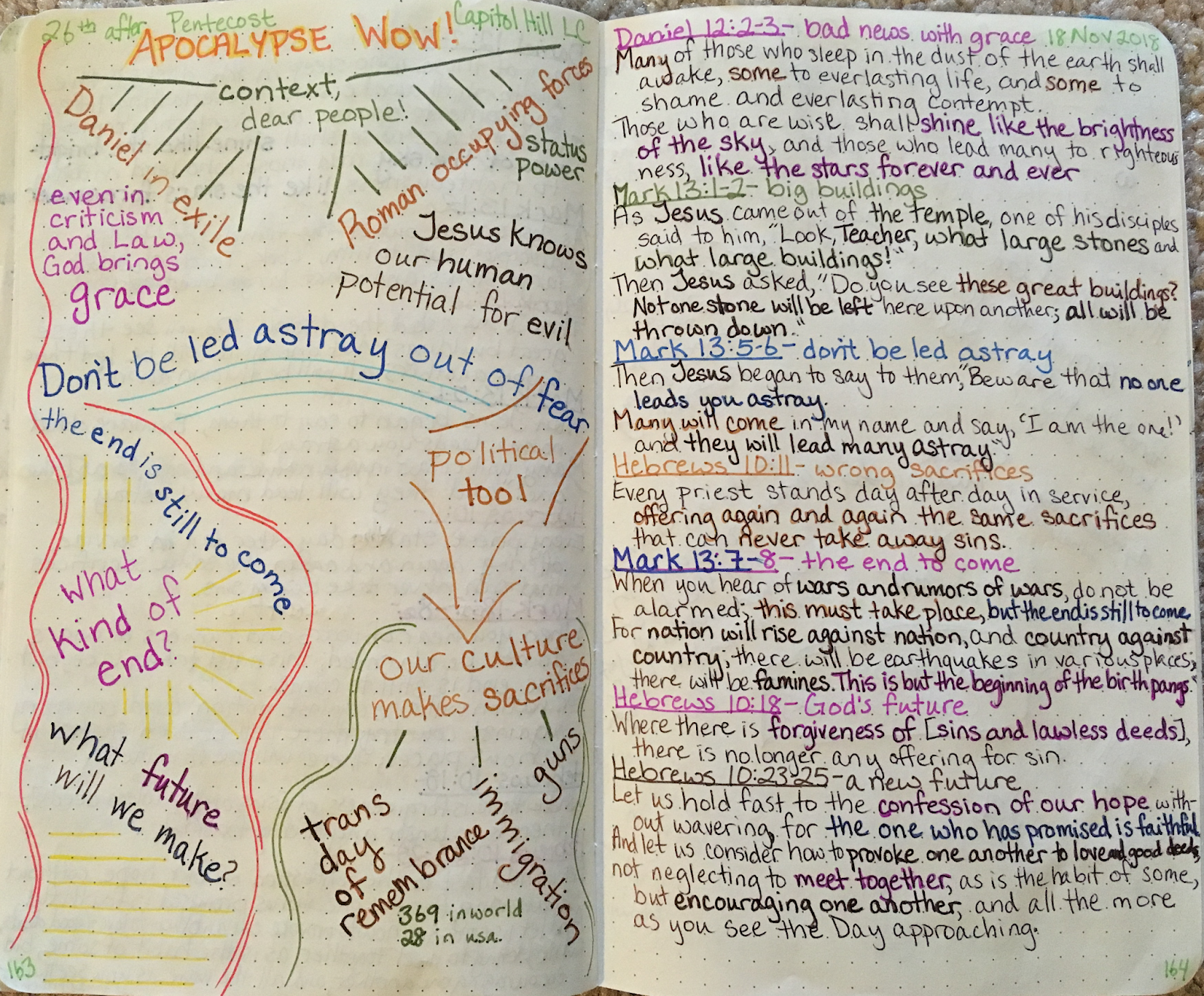
On November 18th, I preached and led worship at Capitol Hill Lutheran Church.  Rooted in my queerying of Mark, as well as my engagement with Daniel and Hebrews, this sermon dove deep into the context of the texts and our understanding of Apocalyptic literature in the bible as well as the reality of humanity's potential for evil.

We explored fear and the ways fear is used as a political tool to make our culture sacrifice people, specifically thinking of gun violence, violence against immigrants, and Transgender Day of Remembrance.  Acknowledging that the end is still to come, the possibilities of what kind of end we will join God in making ended the sermon.


This is the image I preached from for both worship services.

I can clearly tell how this sermon was connected to my queeries, but feel free to let me know if you need help with the connections or have any other comments or questions!


Sunday, October 22, 2017

Who belongs to God: 20th after pentecost a


I also reference the first reading: Isaiah 45:1-7.

El santo evangelio según San Mateo (22:15-22)

15Then the Pharisees went
and plotted to entrap Jesus in what he said.
      16So they sent their disciples to him,
            along with the Herodians, saying,
                  “Teacher,
                        we know that you are sincere,
                        and teach the way of God
                              in accordance with truth,
                        and show deference to no one;
                              for you do not regard people with partiality.
                        17Tell us, then, what you think.
                              Is it lawful to pay taxes to the emperor,
                                    or not?”
18But Jesus,
      aware of their malice, said,
            “Why are you putting me to the test,
                  you hypocrites?
            19Show me the coin used for the tax.”
And they brought him a denarius.
20Then Jesus said to them,
      “Whose image is this, and whose title?”
21They answered,
      “The emperor’s.”
Then Jesus said to them,
      “Give therefore to the emperor the things that are the emperor’s,
            and to God the things that are God’s.”
      22When they heard this,
            they were amazed;
            and they left Jesus
            and went away.

El evangelio del Señor.

-----

you
see your face.
you
see a flaw.
how.  if you are the
only one who has
this face.
     the beauty
construct

(Nayyirah Waheed)


There are images all around us every day.  Images of violence, of pain, of joy, of anger.  Images of jobs and vocations, service, relationships, and estrangement.  Images of power and privilege, of isolation and marginalization.

These diverse images are on our money, too.  An image of a man of power: Washington, Hamilton, Franklin—soon Harriet Tubman, an image of freedom and resistance to oppression.  An eagle – an image for this country, with a head pointing toward the olive branch of peace and away from the arrows of war. 

A pyramid image of endurance, withstanding the test of time, with the Eye of Providence, or is it the eye of God? Claiming God’s presence and blessing, perhaps, though other countries also make that claim.  A new order, this great seal declares.  At the top, the united states of america.  Below that, on the back, the phrase “in god we trust.”  And those are just a few, easily spotted on this one, old bill. 

Images are all around us and even on us.  Images that seem perfect and images so full of what we call flaws: lines of wrinkles from laughter, worry, and surprise trace across our faces; scars from illness or injury; marks we try to cover up or choose to create as art; marks from violence that we hide from others, struggling to seek help or a way out.  All over our bodies, we carry images.

But there is one image more precious and more powerful than the rest.  An image that challenges our assumptions when seen on others whom we might call “interesting” or “different.”  An image that brings comfort when we cannot find the good in our own selves.

Jesus asks, “whose image…whose title?”  and it is “the emperor’s.”  When the image is marked “for the Empire,” then it is for the Empire.  When the image is marked for God, then for God.


Certain images may be marked on money and things, but the everlasting image of the Divine is marked on all of creation and on all of us created beings.  And that makes a difference.  We are made in the image of God.  Together with all of the ways we are unique, we belong to God—the God who calls us by our name and surnames us.

And if we belong to God, it is not just us, but all of humanity.  Every soldier killed fighting for this government, every soldier killed fighting for other governments, even every soldier killed fighting for ISIS bears the image of God and so belongs to God.  Every family that goes hungry on the weekends or in the summer bears the image of God and so belongs to God.  Every billionaire CEO and every family on welfare and everyone just trying to stay in the middle class bears the image of God and so belongs to God. 

Every baby born and every person who dies bears the image of God and so belongs to God.  Every victim of violence—sexual harassment and domestic violence, economic violence, gun violence, terror attacks and mass killings—and every perpetrator of violence bears the image of God and so belongs to God.  Every janitor, firefighter, sex worker, pastor, administrative assistant, nurse, teacher, elected representative, telemarketer, and community organizer bears the image of God and so belongs to God. 

Every person with documentation to live and work in a country, every person without documentation, and every person awaiting deportation bears the image of God and so belongs to God.  Every lawyer, every government employee, every person in prison bears the image of God and so belongs to God.   

Every woman, every man, every transgender person, every person for whom the gender binary doesn’t fit; every bisexual, heterosexual, asexual, lesbian, gay, and queer person bears the image of God and so belongs to God.  Every one who is single, divorced, widowed, struggling with their marriage, and happily married bears the image of God and so belongs to God.

And if all of humanity bears the image of God and so belongs to God, then all of Creation bears the image of God and so belongs to God.  Every tree, river, bush, and lake bears the image of God and so belongs to God.  Every bluff, mountain, valley, desert, sea, and glacier bears the image of God and so belongs to God.  Every creeping thing upon the earth, every swimming thing every flying thing bears the image of God and so belongs to God.  Every planet, moon, star, galaxy, black hole, asteroid, and supernova bears the image of God and so belongs to God.

And if all of creation bears the image of God and so belongs to God, then even “the things that are the emperor’s” are really “the things that are God’s.”  The things we think we can separate out from our faith are a part of our faith.  They belong to God just as we belong to God. 

So in all that we do and use we find divine belonging.  When we spend our money, we are using God’s resources and God’s creation.  When we are spiteful or cruel, we are doing so to God.  When we are honest about pain, oppression, and conflict, we are being honest with God and all that belongs to God.  When we care for another and for ourselves, we care for God.

Nayyirah Waheed’s poem, which I began with holds the truth about this image of God:

you
see your face.
you
see a flaw.
how.  if you are the
only one who has
this face.
     the beauty
construct

(Nayyirah Waheed)

In all you see as a flaw, God recognizes the beauty that is your truest self.  And the same holds true for the flaws we see in others.

As a reminder, please turn to a neighbor, ask their name (just to make sure—if everybody does it the person whose mind goes blank will have an excuse), ask if you can bless them, and if they give permission, mark their forehead or their hands with the sign of the cross and say, “You are a beloved child of God.  You belong to God. And that will never ever change.”


Amen.

Sunday, October 15, 2017

YAGM Wilderness


This is the manuscript that I preached from for the opening worship at this year's YAGM Re-Entry Retreat.

A reading from Mark (1:9-13).

9In those days Jesus came from Nazareth of Galilee
      and was baptized by John in the Jordan.
      10And just as Jesus was coming up out of the water,
            he saw the heavens torn apart
            and the Spirit descending like a dove on him.
      11And a voice came from heaven,
            “You are my Child,
                  the Beloved;
                        with you I am well pleased.”
      12And the Spirit immediately drove Jesus out into the wilderness.
            13He was in the wilderness forty days,
                  tempted by Satan;
            and he was with the wild beasts;
            and the angels waited on him.

Word of God, Word of Life.  Thanks be to God.

-----

I grew up in the mountains of Colorado, so I have always loved the Bible passages about the wilderness.  It’s easy to imagine the wilderness, because it was my back yard growing up.  And it’s beautiful and fun—the snow, the aspen leaves in fall, the bluest of blue skies.  I have always had a fondness for the wilderness.

Then, as I was getting ready to graduate from Luther College, I came here for DIP.  From there, I ended up in a different kind of wilderness in a small village in eastern Slovakia.  Sure, there are hills and even a few mountains in Slovakia, and I got to go hiking and enjoy nature, but this was a different kind of wilderness.

Like the wilderness we find throughout the Bible, this wilderness wasn’t familiar to me and it wasn’t always friendly.  You all have spent a year in the wilderness.  And in that year, a lot has changed.  You have changed.  The people who sent you have changed.  The people you encountered have changed.  This country has changed.  That’s what wilderness does.  It changes you.

Whether you’ve heard the distant rumbles of the heavens being torn apart or encountered wild beasts, doves, or angels—or maybe all of them at once.  You spent a year away from your family, your friends, your loved ones, and that is hard.  I can’t help but think of the words from the song, The Summons, “Will you go where you don’t know and never be the same?”        

You did.  And you probably will again.  And it will still be hard.               It is hard to be different and an outsider.  I still remember those first months in Slovakia, hearing sermons and Bible studies in which I could only pick out a few of the words.  And the sinking feeling I would get in my stomach every time the word I understood was Sodom or Gomorrah, knowing that there was a part of me as a queer person that would never belong.

Maybe for you it was a racist remark, or the violence you witnessed in words or actions, the access your u.s. passport granted you at checkpoints, the parts of the language that always eluded you, or the customs that never quite got explained so that you could understand and participate.

The wilderness doesn’t always make sense, and sometimes it hurts; but the other thing about the wilderness is that that’s where Jesus goes.  Jesus is baptized by John in the Jordan, the heavens are torn apart, God claims Jesus as beloved, and then “the Spirit immediately [drives] Jesus out into the wilderness,” to you.

Because that is what YAGM is about: Jesus finding you—in the hug of your host mom on that extra homesick kind of day, in the kids who are excited about how well they did on the test—or who continue to push your buttons until the day you leave; in the struggles to understand yourself and others, in the quiet moments of just being with another person, drinking mate, talking, singing, laughing, and crying.

We as the church have sent you out into the wilderness and called you back to a new kind of wilderness in this country.  This wilderness is both familiar and foreign, full of love and full of fear and hatred.  The struggles against injustice, the pain of oppression, sorrow, and hardship are not reserved for other countries. They are here, too, as are countless options for which spaghetti sauce or laundry detergent to buy, new and different ways to ride the bus—no longer the crammed rush hour buses of Buenos Aires or the long winding country roads. 

But what may be the hardest about this new wilderness we’ve called you back to is that it seems so much like the land and places and people you called home before; like a place you should know.  Shouldn’t you understand what to do, who and how to be here?  And shouldn’t they understand you?   

But the people, the places, the politics here        have all changed in subtle and obvious ways,                  as have you, so that the ways you seek familiarity and comfort aren’t the same.  The people you are encountering again might not understand why you like different foods, why you need more time to talk or more time to be silent, but together, than you did before. It's wild, this new wilderness.

Your YAGM year may have ended, but this journey in the wilderness has not, and maybe it never will.  Maybe, as you continue to leave your heart in different places, you will always find a wilderness around you—of joyful mountains and snow, of desert and scorching heat, of safety and of danger.  We don’t know.  You can’t know until you get there.

But the promise I have, the promise of God for you, is that Jesus will show up.  In the suffering and struggle as well as the comfort and joy.  Jesus will show up because that’s how the Holy Spirit works—in the most unexpected places and ways—driving Jesus out into the wilderness to meet you.

The Holy Spirit has claimed you.  The voice from heaven claims Jesus and she claims you as well.

You are God’s child, the Beloved, with whom God is well pleased.  And there is no amount of wilderness or struggle or pain or screw up that can make that untrue.  There is no loneliness, isolation, alienation, or oppression that diminishes God’s immense love for you.  And, especially in these days that we have together, there is no questioning, frustration, random burst of laughter or tears, or befuddlement that is more powerful than God’s love for you.  No matter what.

Thanks be to God.

Sunday, October 01, 2017

God's authority is given in baptism: 17th after pentecost a


A reading from Philippians (2:1-13).

1If then there is any encouragement in Christ, any consolation from love, any sharing in the Spirit, any compassion and sympathy, 2make my joy complete: be of the same mind, having the same love, being in full accord and of one mind. 3Do nothing from selfish ambition or conceit, but in humility regard others as better than yourselves. 4Let each of you look not to your own interests, but to the interests of others. 5Let the same mind be in you that was in Christ Jesus,
6who, though he was in the form of God,
  did not regard equality with God
  as something to be exploited,
7but emptied himself,
  taking the form of a slave,
  being born in human likeness.
And being found in human form,
  8he humbled himself
  and became obedient to the point of death—
  even death on a cross.

9Therefore God also highly exalted him
  and gave him the name
  that is above every name,
10so that at the name of Jesus
  every knee should bend,
  in heaven and on earth and under the earth,
11and every tongue should confess
  that Jesus Christ is Lord,
  to the glory of God the Father.

12Therefore, my beloved, just as you have always obeyed me, not only in my presence, but much more now in my absence, work out your own salvation with fear and trembling; 13for it is God who is at work in you, enabling you both to will and to work for his good pleasure.

Word of God, Word of Life.

The other reading I reference is Matthew 21:23-32. 

-----

In the summer of 1523, with the debates and battles of the Reformation in full swing, the faculty of the University of Ingolstadt received a letter challenging their action in forcing a student to recant his support of the Reformation.

What is perhaps most stunning is that Argula von Grumbach, the author of the letter, was the only one speaking out against this injustice and as a woman whose husband was Catholic, the odds were stacked against her.  But von Grumbach had studied the bible and knew about the priesthood of all believers.   

She knew that, as we hear in Philippians, Jesus’ authority comes from God, and she knew that she was entitled to share in that authority.  She embraced the spirit of the Reformation and used her authority and call as a baptized child of God to speak out against injustice.  Truly, we could say to her, “it is God who is at work in you, enabling you both to will and to work for God’s good pleasure.”  God was indeed working through her.

Looking back, it’s clear to us, but it can be harder to recognize God at work in the moment, to acknowledge that God is up to something in us.  That’s partly why we have extended processes for ordination in both the PCUSA and the ELCA.  Recognizing God’s call in us is important, and we also work together as communities of faith to recognize God’s call in each other.

Sometimes the call is to leadership in the community or congregation and sometimes it is to ordination, as was the case when you all recognized and affirmed gifts for ordained ministry in Leah and Carina.

In 1832 the New York Synod recognized that God was calling Jehu Jones to ordained ministry.  Born to enslaved parents who were freed when he was 12, Jones joined a Lutheran congregation in Charleston, South Carolina, which encouraged him to pursue ordained ministry in the North.  Jones became what we would call a mission developer in Philadelphia, founding multiple congregations throughout his ministry.

Jones knew with a greater depth than we could know what it means that Jesus “emptied himself, taking the form of a slave, being born in human likeness.  Jones’ ministry was founded on the authority of God and even as he faced a lack of financial support for his ministries and mission as one aspect of racism in both the culture and the church, he persevered in what God was calling him to do.

The Lutheran Church recognized and affirmed God’s authority at work in Jehu Jones and called him into difficult ministry and Jones persevered through it all.

Then fast forward to 1990 when the predecessor organizations to Extraordinary Lutheran Ministries ordained first Jeff Johnson, Ruth Frost, and Phyllis Zillhart and then in the years leading up to the ELCA’s 2009 policy change they ordained another 15 people who had been banned from ordination in the ELCA due to sexual orientation and/or gender identity.  When these “extraordinary ordinations” took place, it was clear to those working toward policy change that eventually the ELCA would change its policy, and so people talked about borrowing their authority from the future.

They knew God was at work in them, and they knew that “The arc of the moral universe is long, but it bends toward justice," so, in the spirit of the Reformation, they did what was simultaneously controversial and faithful.  They “look[ed] to the interests of others” who would follow in their footsteps toward ordination.

Although this month we will celebrate the 500th anniversary of the beginning of the Protestant Reformation, the Reformation didn’t happen in the 1500s and then stop.  It continues even today.  We continue to find new ways that the Holy Spirit is at work.

As in today’s gospel, we continue to hear people in positions of power question the authority of others to do the work of God, but Jesus still responds, pointing to the work of ordinary people like John the Baptist, Argula von Grumbach, Jehu Jones, Jeff Johnson, Ruth Frost, and Phyllis Zillhart, whose power and authority come by the Holy Spirit.

In Philippians, we hear the exhortation, “5Let the same mind be in you that was in Christ Jesus, 6who, though he was in the form of God, did not regard equality with God as something to be exploited, 7but emptied himself, taking the form of a slave, being born in human likeness.  And being found in human form, 8he humbled himself and became obedient to the point of death—even death on a cross.

9Therefore God also highly exalted him and gave him the name that is above every name, 10so that at the name of Jesus every knee should bend, in heaven and on earth and under the earth, 11and every tongue should confess that Jesus Christ is Lord, to the glory of God the Father.”

Who else has heard this exhortation?  Who else proclaims this Good News?  Are there others today who humble themselves—perhaps in controversial ways—to look to others’ interests?

We don’t need to be powerful in this world to make a difference.  God empowers each of us.  Argula von Grumbach made a big difference without much power.  Jehu Jones’ persistence testified to God’s authority at work in him who was born into slavery.  Without those first 3 or 18 extraordinary ordinations, there wouldn’t be 274 publicly identified lesbian, gay, bisexual, transgender, and queer members in Proclaim.

Jesus’ controversial claims, like the one in today’s gospel, are part of following Jesus.  They’re intended to make us and others think.  So as we wonder about Jesus’ controversies we can also wonder: when Colin Kaepernick takes a knee, who is it for?  When the president tweets, when a protest is held, when something happens that rubs us the wrong way or makes us feel defensive, what is the real issue and how does it impact the most vulnerable?

Protests and controversies aren’t intended to make us comfortable, but they make us wonder with the crowd around Jesus: whose authority is most important?  How is God at work?  What would Jesus have to say about helping hurricane recovery in Puerto Rico, about the importance of the lives of Black people who face racism daily, about the immigrants in our community who face discrimination, and about those who will be banned from this country by the newest travel ban?

Jesus preaches and teaches with divine authority and as we follow him, he calls us to “look not to your own interests, but to the interests of others,” to bend our knee at the name of Jesus and in service to others, because that is God’s call for us in baptism.

Thanks be to God.