Today, I preached at Trinity las Americas United Methodist Church (TLA). My sermon was rooted in my queerying the text this week.
This Sunday is the Sunday before the 20th annual Trans Day of Remembrance, so that was a big part of my sermon. Below is the manuscript. Because TLA is multicultural and worships bilingually, the sermon also is bilingual.
I'm doing my best to include the manuscript more or less as it was preached. The italicized is English and bold is Spanish.
Isaiah 65:17-25
17 For I am about to create
new heavens
and a new earth;
the former things shall not be remembered
or come to mind.
18 But be glad and rejoice forever
in what I am creating;
for I am about to create Jerusalem as a joy,
and its people as a delight.
19 I will rejoice in Jerusalem,
and delight in my people;
no more shall the sound of weeping be heard in it,
or the cry of distress.
20 No more shall there be in it
an infant that lives but a few days,
or an old person who does not live out a lifetime;
for one who dies at a hundred years will be considered a youth,
and one who falls short of a hundred will be considered accursed.
21 They shall build houses and inhabit them;
they shall plant vineyards and eat their fruit.
22 They shall not build and another inhabit;
they shall not plant and another eat;
for like the days of a tree shall the days of my people be,
and my chosen shall long enjoy the work of their hands.
23 They shall not labor in vain,
or bear children for calamity;[a]
for they shall be offspring blessed by the Lord—
and their descendants as well.
24 Before they call I will answer,
while they are yet speaking I will hear.
25 The wolf and the lamb shall feed together,
the lion shall eat straw like the ox;
but the serpent—its food shall be dust!
They shall not hurt or destroy
on all my holy mountain,
says the Lord.
-----
Isaías 65:17-25
17 »Miren, yo voy a crear
un cielo nuevo y una tierra nueva.
Lo pasado quedará olvidado,
nadie se volverá a acordar de ello.
18 Llénense de gozo y alegría para siempre
por lo que voy a crear,
porque voy a crear una Jerusalén feliz
y un pueblo contento que viva en ella.
19 Yo mismo me alegraré por Jerusalén
y sentiré gozo por mi pueblo.
En ella no se volverá a oír llanto
ni gritos de angustia.
20 Allí no habrá niños que mueran a los pocos días,
ni ancianos que no completen su vida.
Morir a los cien años será morir joven,
y no llegar a los cien años será una maldición.
21 La gente construirá casas y vivirá en ellas,
sembrará viñedos y comerá sus uvas.
22 No sucederá que uno construya y otro viva allí,
o que uno siembre y otro se aproveche.
Mi pueblo tendrá una vida larga, como la de un árbol;
mis elegidos disfrutarán del trabajo de sus manos.
23 No trabajarán en vano
ni tendrán hijos que mueran antes de tiempo,
porque ellos son descendientes
de los que el Señor ha bendecido,
y lo mismo serán sus descendientes.
24 Antes que ellos me llamen,
yo les responderé;
antes que terminen de hablar,
yo los escucharé.
25 El lobo y el cordero comerán juntos,
el león comerá pasto, como el buey,
y la serpiente se alimentará de tierra.
En todo mi monte santo
no habrá quien haga ningún daño.»
El Señor lo ha dicho.
-----
This
Wednesday is Trans Day of Remembrance, or TDOR. Every year on November 20, we gather
and read all the names that we know of the transgender people who have died in
the last year. Although the list can often include some of those who died by
suicide, the majority of trans people who died were intentionally killed. This
year we know of 369 trans people who died. 36 of them have been killed or died
here in the United States. One trans woman died in prison on Riker's Island, New York, and
another was in ICE custody. The vast majority of those killed in the united
states are Black trans women.
El miércoles que viene es el día internacional de la memoria trans. Cada año el 20 de noviembre, nos reunimos y leemos todos los nombres que conocemos de las personas transgénero que se murió en el año pasado. Aunque muchas veces incluye algunas de las personas que se murieron por medio del suicidio, la mayoría de personas trans que se murieron es matada. Este año sabemos de 369 personas trans que se murieron. 36 de estas personas han sido asesinadas o se han muerto aquí en los estados unidos. Una mujer trans se murió en la cárcel en Riker’s Island, Nueva York, y otra fue en la custodia de la migra. La mayoría en los ee uu es mujeres descendientes de Africa.
Cada noviembre leemos cientos de nombres y sentimos como si fuera inevitable hacerlo cada año. Es como pensaron el pueblo de Israel en la lectura de hoy. La gente está regresando del exilio y no sabe como encontrará la vida nueva. Piensa en el exilio como si fuera inevitable otra vez.
Every November we read hundreds of names and it feels like the next Trans Day of Remembrance is inevitable, much as the people of Israel thought in today's reading. They are a people returning from exile with no idea how they will find a new life—or if there even is life after exile.
It was easy for them to resign themselves to an exiled life forever, and it is easy for us now to think that violence against trans people will always exist — that racism, sexism, and transphobia will never end, but our God says otherwise. God says, “For I am about to create new heavens and a new earth; the former things shall not be remembered or come to mind.” And God continues with this new vision, saying, “No more shall there be in it an infant that lives but a few days, or an old person who does not live out a lifetime; for one who dies at a hundred years will be considered a youth, and one who falls short of a hundred will be considered accursed. They shall build houses and inhabit them; they shall plant vineyards and eat their fruit.”
Era fácil para la gente regresando del exilio y es fácil para nosotrxs pensar que la violencia contra personas trans siempre estará—que el racismo, el sexismo, y la transfobia siempre existirán, pero nuestro Dios dice que no. Dios dice, “Miren, yo voy a crear un cielo nuevo y una tierra nueva. Lo pasado quedará olvidado, nadie se volverá a acordar de ello.” Y sigue con una vista de vida, diciendo, “Allí no habrá niños que mueran a los pocos días, ni ancianos que no completen su vida. Morir a los cien años será morir joven, y no llegar a los cien años será una maldición. La gente construirá casas y vivirá en ellas, sembrará viñedos y comerá sus uvas.”
Dios tiene otro plan para nosotrxs y para el mundo entero.
God has another plan for us and for the whole world.
It is not an easy plan to achieve — it never is. It requires major changes in how we function as human beings and in our cultures. God’s vision that “the wolf and the lamb shall feed together, the lion shall eat straw like the ox;” requires changes on the part of the wolf and the lion. It’s not possible for the wolf and the lamb to eat together if the wolf is eating the lamb.
No es fácil alcanzarlo—nunca es fácil seguir a Dios. Requiere grandes cambios en como funcionamos como seres humanos y como culturas. El plan de Dios, que “El lobo y el cordero comerán juntos, el león comerá pasto, como el buey” requiere un cambio fundamental por parte del lobo y del león. No es posible que el lobo y el cordero coman juntos si el lobo esta comiendo el cordero.
Para crear un mundo donde toda la gente puede vivir sin miedo, la gente con poder—la gente que han abusado su poder, que han hecho más difícil la vida para la gente marginalizada—los lobos, no pueden tener tanta poder—no pueden comer a los corderos. El poder que tienen sobre otras personas es poder sin amor y poder injusto. Hay que enfrentarse con las consecuencias de sus acciones. La cultura necesita cambiar para que los lobos no puedan hacer daño a otras personas.
To create a world where all people can live without fear, people with power — people who have abused their power, who have made life harder instead of easier for marginalized people — the wolves and lions, cannot have all that power. The power they have over other people is power without love—it is unjust power. The wolves must face the consequences of their actions. Culture needs to change so that they cannot harm other people.
And we, here, can be part of the change that God makes. We have power. We especially have power together as this community of faith. But also, every person here — some more than others, but each person — has power. We can honor each person, protect the most vulnerable people, share power, and limit the damage done.
Y nosotrxs aquí somos parte del cambio que hace Dios. Tenemos poder. Especialmente tenemos poder juntos como comunidad de fe. Pero también cada persona aquí—algunas más que otras, pero cada persona—tiene poder. Somos capaces de honrar a cada persona, de dar protección a la gente más vulnerable, a compartir el poder y limitar el daño hecho.
Tenemos el poder de corregir unos a otros cuando decimos los pronombres incorrectos, cuando alguien habla de “esas personas.” Nuestras acciones solo son una parte, pero son una parte importante, especialmente ahora que el gobierno no funciona bien. Lo que podemos hacer, tiene que ver con nuestres amigues, nuestras comunidades.
We have the power to correct each other when we say the wrong pronouns, when someone talks about “those people.” Our actions are only one part, but they are an important part, especially when the government feels so hopeless. What we can do has to do with our friends and our communities.
Pastor Alejandro has asked about great, great, grandmothers. I will ask about friends and friends of friends. Can we talk to our friends about racism, sexism, and transphobia? Can we speak up about these things when we´re in a group and don´t know everyone in the group? When trans people aren’t present? When it is just white folks? How can we influence our neighbors for the good?
Pastor Alejandro preguntó de las tatarabuelas. Yo pregunto de les amigues de les amigues. ¿Podemos hablar con nuestres amigues sobre el racismo, el sexismo, y la transfobia? ¿Podemos decir algo, cuando estamos en un grupo y no conocemos a cada persona en el grupo? ¿Cuando personas trans no estén presentes? ¿Cómo podemos influir a nuestras projimas?
Dios está creando un mundo nuevo, está llamándonos, ¿seguimos a Dios? ¿Creemos en la posibilidad de otro tipo de mundo? Podemos hacerlo juntxs.
God is creating a new world, God is calling us. Do we follow God? Do we put our faith in the possibility of a different kind of world? We can do it together.
Amén.
Showing posts with label stoptransmurders. Show all posts
Showing posts with label stoptransmurders. Show all posts
Sunday, November 17, 2019


Wednesday, November 21, 2018
the end is still to come: 26th after pentecost year b
On November 18th, I preached and led worship at Capitol Hill Lutheran Church. Rooted in my queerying of Mark, as well as my engagement with Daniel and Hebrews, this sermon dove deep into the context of the texts and our understanding of Apocalyptic literature in the bible as well as the reality of humanity's potential for evil.
We explored fear and the ways fear is used as a political tool to make our culture sacrifice people, specifically thinking of gun violence, violence against immigrants, and Transgender Day of Remembrance. Acknowledging that the end is still to come, the possibilities of what kind of end we will join God in making ended the sermon.
I can clearly tell how this sermon was connected to my queeries, but feel free to let me know if you need help with the connections or have any other comments or questions!
We explored fear and the ways fear is used as a political tool to make our culture sacrifice people, specifically thinking of gun violence, violence against immigrants, and Transgender Day of Remembrance. Acknowledging that the end is still to come, the possibilities of what kind of end we will join God in making ended the sermon.
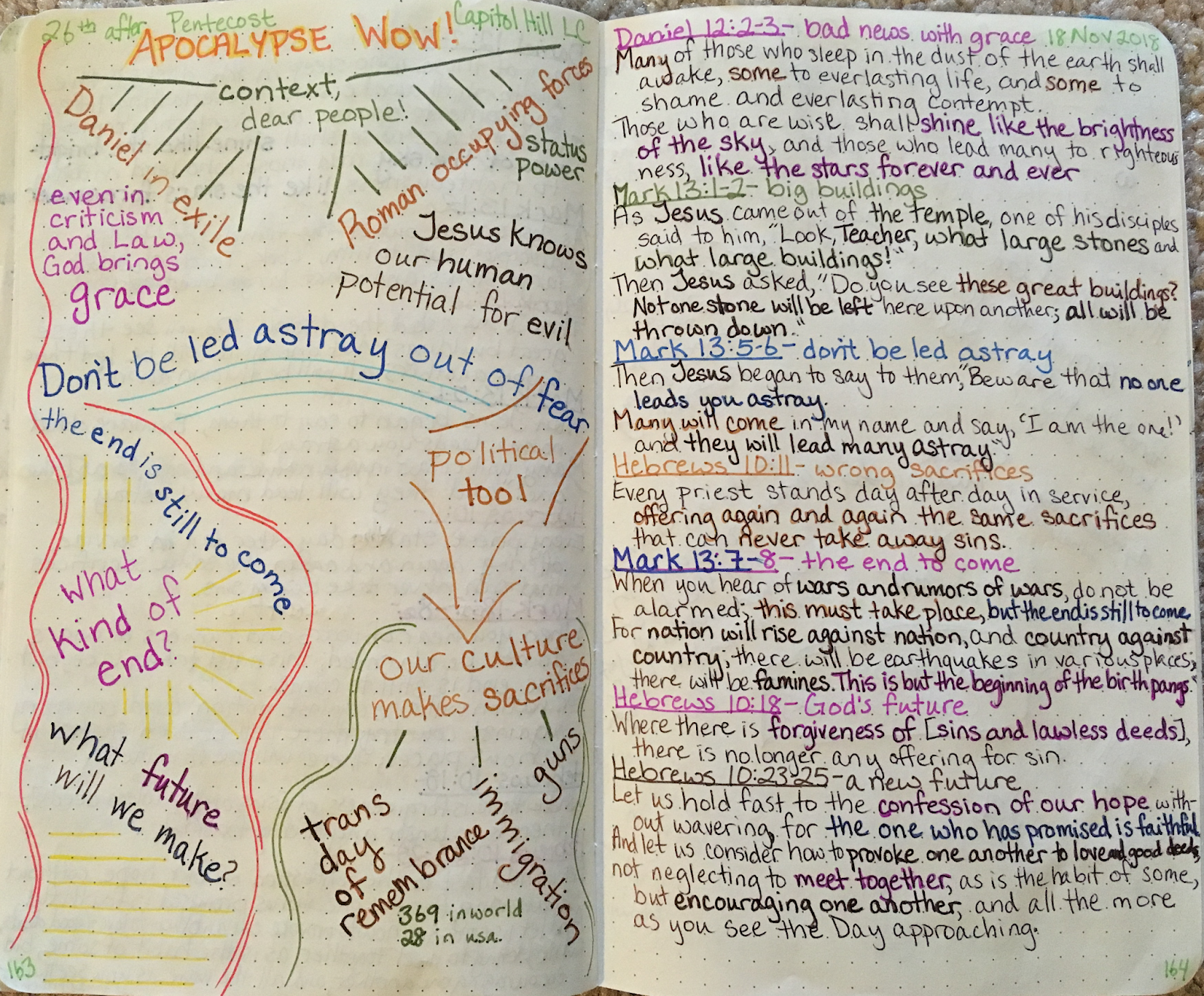 |
| This is the image I preached from for both worship services. |
I can clearly tell how this sermon was connected to my queeries, but feel free to let me know if you need help with the connections or have any other comments or questions!
Sunday, November 20, 2016
Christ shows up in the suffering: Reign of Christ
The other reading referenced is Colossians 1:11-20.
The
holy gospel according to Luke (23:33-43)
33When
they came to the place that is called The Skull,
they
crucified Jesus there with the criminals,
one
on his right
and
one on his left.
34⟦Then
Jesus said,
“Father,
forgive them;
for
they do not know what they are doing.”⟧
And
they cast lots to divide his clothing.
35And
the people stood by, watching;
but
the leaders scoffed at him, saying,
“He
saved others;
let
him save himself if he is the Messiah of God,
the
chosen one!”
36The
soldiers also mocked him,
coming
up and offering him sour wine, 37and saying,
“If
you are the King of the Jews,
save
yourself!”
38There
was also an inscription over him,
“This is the King of the Jews.”
39One
of the criminals who were hanged there kept deriding Jesus and saying,
“Are
you not the Messiah?
Save
yourself and us!”
40But
the other rebuked him, saying,
“Do
you not fear God,
since
you are under the same sentence of condemnation?
41And
we indeed have been condemned justly,
for
we are getting what we deserve for our deeds,
but
this one has done nothing wrong.”
42Then
he said,
“Jesus,
remember me when you come into your kindom.”
43Jesus
replied,
“Truly
I tell you, today you will be with me in Paradise.”
The
gospel of the lord.
-----
Today,
as the final Sunday in the church year, is Reign of Christ Sunday. It is the
day we name Christ as the ultimate authority over all. We celebrate our God who has all the
power.
When
we say Christ reigns or Christ is King or Lord—or, in today’s language we might
say, Christ is our President—we are making a statement about whose authority we
follow. This is the day that our
Gospel reading especially gives us great insight not only into who Jesus is,
but more deeply into what power and authority mean to God.
What
do they mean? How do we best
understand Jesus?
Through
the cross.
Christ’s
reign—Jesus’ power and authority—is best understood in the One who would rather
die than kill anyone, who talks to criminals, and challenges the assumptions of
his day; the One who doesn’t give into complacency, the One willing to suffer
for another.
As
Jesus suffers and dies on the cross, we find that, as the letter to Colossians
says, “in Christ all the fullness of God
[is] pleased to dwell.” When
all of God’s power and might is on display, that power places itself below—it
takes on the suffering of the world. God becomes incarnate—taking on our very
flesh all the way to the cross, so that when we proclaim that Christ reigns, it
is really that Christ is most present in and with those who suffer.
Christ
shows up when we’re filled with anxiety at unmarked cars driving by and word of
Immigration and Customs Enforcement, la migra, in the area. Christ sits with us in our anxiety,
recalling what it was like when his own family had to flee his home country and
live without papers in a strange land.
Christ
shows up when the doctor calls about the biopsy and says we should come in to
talk to her. In the waiting and
the heartbreak, in the treatment and the sickness. Christ sits with us in our pain, recalling the pain of the
cross.
Christ
shows up when we wonder if it’s safe to go out in public because at least 295
of our transgender and gender nonconforming siblings were killed this year just
because of their gender identity—23 in this country alone. Christ sits with us in our fear and
dies with us in our death, crucified again and again with each person killed.
Christ
shows up.
Whenever
and wherever there is suffering, Christ is there.
Tears
rolling down, beaten and broken by people or life itself, Christ shows up. That is the God we know and the God we
worship. The One who shows
up. The One who takes on all our
suffering.
Because
God has literally been to hell and back, there is no experience too foreign,
too painful, or too awful, for God.
Christ
gathers “all the strength that comes
from God’s glorious power” and sits down in the sackcloth and ashes. Christ relocates the power and
authority from the places we usually look to, to the places of suffering. For Christ, power exists to be given up
and given over, because no matter how loud or how strong we try to become,
strength and power cannot have the final word for a God who gave it all up to
come be with us.
It’s
like Kid President says, “Even if hate has a bullhorn, Love is louder.” It is love—in solidarity—that has
the final say.
It
is in our ability to be with—to be in solidarity with those who suffer—that we
also encounter Christ’s truest self.
When we sit and breathe, when we go to doctor’s appointments, when we
cry, we encounter Christ with us.
So
we follow Christ—our Lord, King, and President. We follow Jesus to the cross and we look on wondering what
to do about that one who suffers.
Do we stand by watching with the crowd? Do we scoff, mock, and deride? Or, like the criminal, do we ask Jesus to recognize us, to
draw us in?
And
Christ does—Christ always will.
Again and again Christ shows up.
When fear, anxiety, illness, and even death overwhelm us, Christ shows
up in full.
Sometimes
we recognize it and sometimes we don’t. But Christ is still there.
Christ
is in the brokenness. There is an
art form in Japan called Kintsugi where broken pottery is repaired with gold so
that the thing that was broken becomes even more beautiful in the brokenness—a
new thing is born out of the old that would be discarded or destroyed.
That
is Christ’s work. In communion,
Christ, the bread that is broken, connects us to each other and to God. Our broken bodies come for broken bread
and become one body of Christ. In
Christ’s fullness, bread is broken, wine is poured—and Jesus gathers all the
brokenness of the world to himself on the cross and fills our cracks, our
anxiety, illness, and pain with a love that casts out fear. Christ’s presence in communion fills us
and Christ walks with us in our fear through a dangerous world, through a sick
world, through a scary world.
Christ
shows up and Christ shows up on the cross. Perfect power and authority made known in perfect love and
service, not because it is required, but precisely because it is so freely
given.
That
is who Christ is. Christ, our
King, Lord, and President, is Christ crucified, Christ who suffers with the
suffering ones.
Thanks
be to God
Sunday, January 31, 2016
Jesus' love brings the Table to the margins: 4th after epiphany
The first reading is Jeremiah 1:4-10.
The second reading is 1 Corinthians 13:1-13.
The holy gospel according to Luke (4:21-30).
21Then
Jesus began to say to all in the synagogue in Nazareth,
“Today this scripture has been fulfilled in
your hearing.”
22All
spoke well of him
and were amazed
at the gracious words that came from his mouth.
They
said,
“Is not this
Joseph’s son?”
23Jesus
said to them,
“Doubtless you
will quote to me this proverb,
‘Doctor,
cure yourself!’
And you will say,
‘Do
here also in your hometown
the
things that we have heard you did at Capernaum.’”
24And
he said,
“Truly I tell
you,
no
prophet is accepted in the prophet’s hometown.
25But
the truth is,
there were many widows in Israel in the
time of Elijah,
when
the heaven was shut up three years and six months,
and
there was a severe famine over all the land;
26yet
Elijah was sent to none of them
except
to a widow at Zarephath in Sidon.
27There were also many lepers in Israel
in the time of the prophet Elisha,
and
none of them was cleansed
except
Naaman the Syrian.”
28When
they heard this,
all in the synagogue were filled with rage.
29They
got up,
drove
Jesus out of the town,
and
led him to the brow of the hill on which their town was built,
so
that they might hurl him off the cliff.
30But
Jesus passed through the midst of them
and
went on his way.
The gospel of the Lord.
-----
Today
we celebrate God’s love.
Specifically we celebrate God’s love for people and communities that
churches have not always loved. We
celebrate God’s claim on our lives as God tells Jeremiah, “Before I formed you in the womb I knew you, and before you were born
I consecrated you; I appointed you a
prophet to the nations.” God
knows each of us intimately and has known us even before we’ve known ourselves.
While
our culture is changing, it still has a ways to go. It takes many of us in the lesbian, gay, bisexual,
transgender, and queer community years and even decades to come out to
ourselves and to others, to accept the love that God has for all of us. It takes time because the assumption is
that we are straight, not gay or bi, cisgender—that is, people whose deepest
sense of self matches society’s expectations of them from birth, not
transgender or queer. It takes
time because communities of faith and groups in our culture still say that we
are not welcome, we are not loved.
But those messages are not the messages of God. God’s message is love.
What
a comfort that for all of us in our lives as sinners and saints, in our brokenness and the ways that we fall short, in
the ways society declares us not good enough, God knows us all and loves us completely. And precisely in the ways we are
different—our diversity of sexual orientation, our diversity of gender identity
and expression, our diversity in immigration status. The ways that we are different from the norm, excluded,
ignored, or pushed down are
ways that God is uniquely at work in and through us.
Jeremiah
thinks he is unable to do what God is calling him to do because he is “only a
child.” What is God’s response? “Do not say, ‘I am only a child’; for
you shall go to all to whom I send you, and you shall speak whatever I command
you, 8Do not be afraid of
them, for I am with you to deliver you, says the Lord.” Because it’s about more than what the
world and even some churches see and say.
It’s
about God’s love, which comes before and will last long after everything
else. It is God’s love that
gathers us here for worship. It is
God’s love that nourishes us at the Table with bread, wine, and Word. It is God’s love that sends us out,
following Jesus into the needs and messy-ness in the world.
It
is God’s love that comes to us in Jesus.
And no matter what else we might do, it is, as Paul points out, only
with God’s love that any of it has
meaning. Knowledge, faith,
generosity…none of it holds meaning without love, and, love transforms all of it.
This
transformative love can only be known in community. The love Paul talks about is a love in community, love that
is bigger and deeper than the many things that have been dividing the people in
Corinth and the people in our own country. In the community in Corinth, each person and group wants to
be best and in striving for that, they lose the love that grounds them and
guides them; they lose the love that brings them together to listen and learn
from each other.
This
love is what Jesus is talking about in the gospel as well. It is this love that pushes Jesus into
the world. That guides his claim
not to be sent to the people already within his community, but to those
outside, to the widows in the Zeraphaths of the world and the Namaans in the
Syrias of the world. And it is
that love that also pushes us out the doors into the world—into ESL classes and
backpack programs, witnessing to God’s love through our actions and through our
relationships.
It
doesn’t come without risk; the crowd in the synagogue gets so consumed with rage
that Jesus is not there to support and affirm their own personal faith,
righteousness, or agenda, that it’s like a switch flicks and they lose all
of the wonder and love they had just moments ago been expressing for
Jesus.
When
they realize that Jesus is there for the others that they aren’t concerned
about, they don’t just leave him and look for another who might focus solely on
them, the way they want; they are so offended that they are consumed with
rage! They drive Jesus to the edge
of the cliff to hurl him off!
Too
frequently that is what happens when people, especially those with power or
privilege, are confronted with the reality that we are not actually at the
center. That God’s love might also
center on others. This is clear in
reactions to the #BlackLivesMatter movement and in reactions to increasing
rights and protections for LGBTQ folks.
Neither of these groups put themselves against white or straight and
cisgender people.
Like
Jesus, they lift up those who have been left out; and in reaction, those “on
the inside” are filled with rage—inspired by a fear of losing their power and
privilege, losing their special place.
The
reaction is clear today in increased violence against LGBTQ people, especially
those who are transgender and especially people of color, who are the most
vulnerable in the community. Just
this week a transgender Latina named Monica was shot and killed in Austin, TX,
the first reported death in this country of a transgender person this year; and
it is clear in threats and violence against people and communities of color
struggling for rights and for safety.
These
attacks and threats and continued degradation and dismissal happen, quite frequently,
from people who profess themselves to be Christians, followers of Christ.
But
in doing these things, they miss Jesus’ point. He has not come to replace the folks in Nazareth, and he has
not come to replace white people or folks who are straight. Jesus comes in love for the love and
dignity of all people and when some
are denied that love, that dignity, that respect by society or by the church,
then Jesus’ love is poured out all that much more on them.
That
is what we celebrate today. Jesus,
out of God’s immense love, not only makes a space, an opening, at the Table for
people of all sexual orientations and gender identities and expressions, for
people of all immigration statuses and all cultures, but that Jesus also brings
the Table to those who are oppressed and marginalized.
That
God’s love shows up especially at the margins and especially in the people it
is so easy for us to disrespect, ignore, and exclude. But that’s where Jesus goes, oftentimes unnoticed by the
ones inside, the ones filled with rage, blood pumping in their ears, rushing to
the cliff’s edge.
…And
Jesus goes on his way. Jesus goes
to those who are overlooked. Jesus
goes to the ones we tell him not to bother with. Jesus goes to the margins. And creates the space there so that we can follow him. So that we can find his love outpoured,
the community he creates, the relationships and love that transform us all.
Thanks
be to God.
Subscribe to:
Posts (Atom)