Showing posts with label lutheran. Show all posts

Monday, December 03, 2018

God fulfills Their promises: advent 1 year c

Sunday I preached again at Capitol Hill Lutheran Church for the first Sunday of Advent.  The day before, Capitol Hill had hosted the ordination of Pastor Nat Bothwell, whose spouse, Pastor Minna Bothwell, serves as pastor of Capitol Hill.  I drew on River Needham's queery of Jeremiah as well as my queery of Luke for this sermon.

I explored the meaning of Advent as well as the places of distress, fear, and foreboding in our lives and country, challenged by God who fulfills Their promises and the ways God's Word is powerful as well as the glimpses we get, like snowflakes on a dull, gray winter day or stars only visible in the dark of night.

This is the image I preached from at both worship services.

I notice the connections between the queeries and the final sermon, but if you're curious or have any other comments or questions, let me know!

Wednesday, November 21, 2018

the end is still to come: 26th after pentecost year b

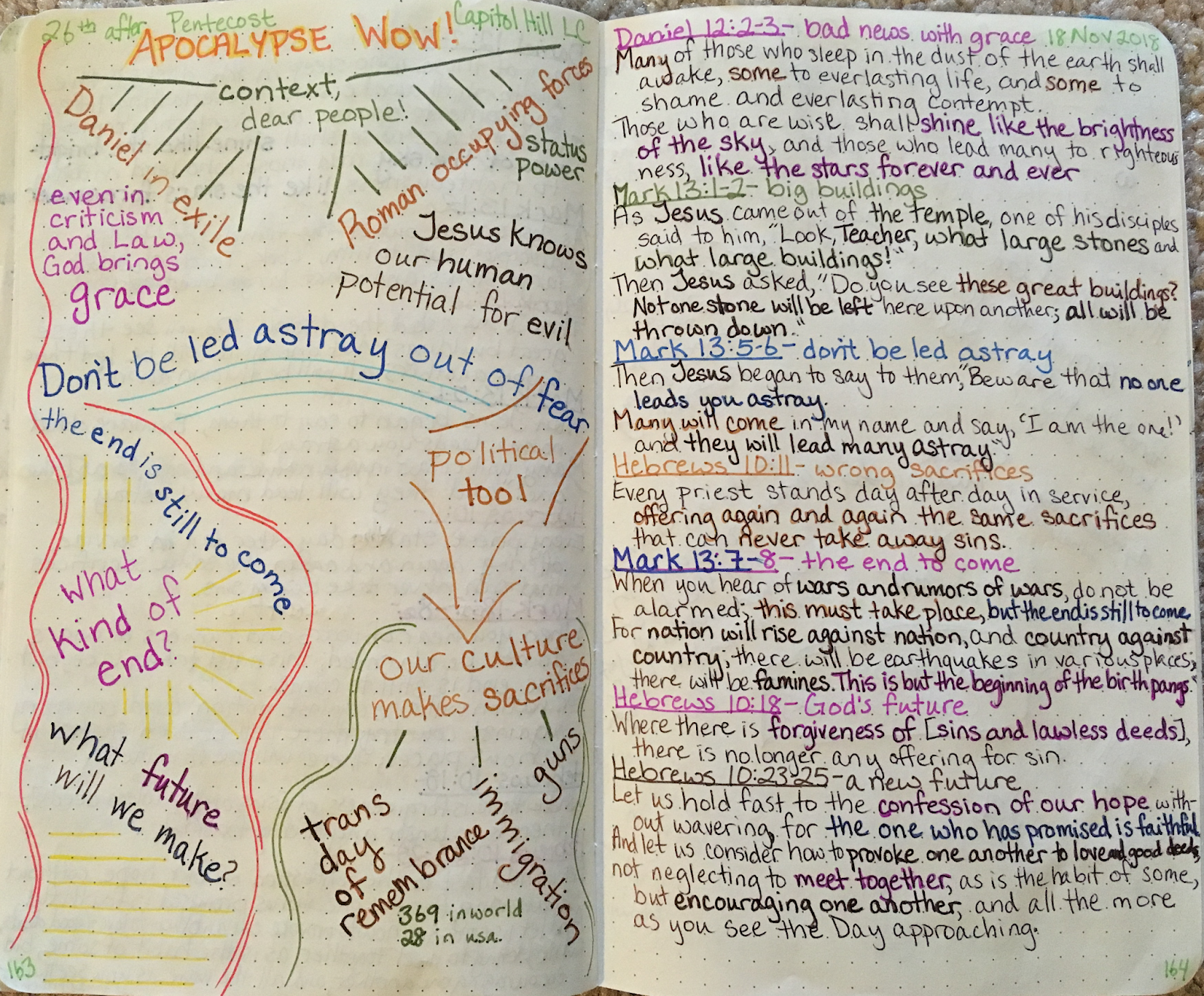
On November 18th, I preached and led worship at Capitol Hill Lutheran Church.  Rooted in my queerying of Mark, as well as my engagement with Daniel and Hebrews, this sermon dove deep into the context of the texts and our understanding of Apocalyptic literature in the bible as well as the reality of humanity's potential for evil.

We explored fear and the ways fear is used as a political tool to make our culture sacrifice people, specifically thinking of gun violence, violence against immigrants, and Transgender Day of Remembrance.  Acknowledging that the end is still to come, the possibilities of what kind of end we will join God in making ended the sermon.


This is the image I preached from for both worship services.

I can clearly tell how this sermon was connected to my queeries, but feel free to let me know if you need help with the connections or have any other comments or questions!


Sunday, October 21, 2018

Jesus liberates all people from power and oppression: 22nd after pentecost year b

One of the perks of doing pulpit supply in different contexts is that if an illustration works well two weeks in a row, I can use it both weeks.  This was one of those occasions.

The sermon was based on the gospel reading for today (plus the missing verses between last week and this week), using Archbishop and Saint, Oscar Romero, and the Catholic Church in El Salvador's story, including the acknowledging the u.s. role in the dictatorship that ultimately made a martyr of Saint Oscar. 

Additionally, Martin Luther's Freedom of a Christian connected well, reminding us that as followers of Christ we are simultaneously totally free subject to none and also servants of all.

I drew heavily on my queery for Mark.  If you have any questions about he connections to it, please let me know!

This is the image for my sermon.

I preached three different times over the course of my weekend and so the sermon itself grew and changed over time.  If you have any questions or insights, let me know!


Monday, October 15, 2018

jesus invites us into radical inversion: 21st after pentecost year b

This past weekend I preached at Capitol Hill Lutheran Church here in Des Moines.  While the sermon changed quite a bit from the first draft to the final, it remained rooted in my queerying of Mark 10:17-31.  I did record the sermon at one of the services, but don't have a way to host that much audio on my blog (but if you support me through ko-fi, I might be able to make it happen!).


This is the image I used for preaching.

In the gospel Jesus challenges a rich man who wants to know how to inherit eternal life and, in doing so, challenges notions of the Prosperity Gospel, inviting the man and all of us as Jesus' followers to a radical inversion of the way the world works.  As we celebrated Archbishop and Saint Oscar Romero's canonization, we also remembered the way God had worked that very inversion in Saint Romero in his lifetime.  If you'd like to know more about the sermon or connections to the queery, let me know!

Wednesday, October 03, 2018

Jesus gets serious about stumbling: 19th after pentecost b

This past weekend, I preached at a congregation I had never been to.  I drew heavily on both River Needham's queery of Numbers and my own queery of Mark to craft the sermon using my usual method.  The events of last week, especially the hearings for the Supreme Court justice, heavily informed my sermon.

Fun fact not included in my sermon: foot is frequently used in the bible to refer to genitalia,
so when Jesus says "If your foot causes you to stumble, cut it off..." you know what that means!

If you have any questions or want to know more about my sermon, let me know!

Monday, April 16, 2018

Jesus' resurrection is for bodies: easter 3 year b


The holy gospel according to Luke. (24:36b-48)

[36While they were talking about this,]
Jesus Themself stood among the eleven and their companions and said to them,
     “Peace be with you.”
37The disciples were startled and terrified,
     and thought that they were seeing a ghost.
38Jesus said to them,
     “Why are you frightened,
     and why do doubts arise in your hearts?
          39Look at my hands and my feet;
               see that it is I myself.
                    Touch me and see;
                         for a ghost does not have flesh and bones 
                              as you see that I have.”
40And when Jesus had said this,
     They showed them Their hands and feet.
     41While in their joy those gathered were disbelieving and still wondering,
          Jesus said to them,
               “Have you anything here to eat?”
                    42They gave Jesus a piece of broiled fish,
                         43and Jesus took it and ate in their presence.
44Then Jesus said to them,
     “These are my words that I spoke to you while I was still with you—
          that everything written about me
               in the law of Moses, the prophets, and the psalms must be fulfilled.”
45Then Jesus opened their minds to understand the scriptures,
     46and said to them,
          “Thus it is written,
               that the Messiah is to suffer 
                    and to rise from the dead on the third day,
               47and that repentance and forgiveness of sins is to be proclaimed
                    in Their name to all nations,
                         beginning from Jerusalem.
          48You are witnesses of these things.”

The gospel of the Lord.

------

A couple weeks ago, Rev. Beth Wartick, a colleague in this synod, posted on Facebook, “Friends: the resurrection is for bodies.”  The post was a bit unsettling at first, because I think I’ve gotten pretty used to making the resurrection into an exclusively spirit and soul-centered or even an intellectual reality, I like to talk about it, but I’m less sure about its physicality. Our resurrection accounts both last week and this week, however, provide us with ample evidence for her statement.

Last week we encountered Jesus in the gospel of John presenting hands, feet, and side to the slow-to-believe and fear-filled disciples, prompting Thomas’ great declaration of faith, “My Lord and my God!”

Jesus’ presentation of Their actual resurrected body, wounds and all, speaks to the disciples in a way that no number of eye-witness accounts could have, and this week’s resurrection account is no different.

Jesus has just spent the day walking along the road to Emmaus with Cleopas and another disciple, explaining everything that Holy Week—Maundy Thursday, Good Friday, and that very Resurrection morning—meant.  Jesus had literally and figuratively walked them through all of scripture, interpreting it just for them.

But it wasn’t until Jesus sat with them and blessed and broke bread—the nourishment for their own bodies—that they recognized the Resurrected One.  And when Jesus shows up with the rest of the disciples in today’s reading, it is once again about the body: “39Look at my hands and my feet; see that it is I myself. Touch me and see; for a ghost does not have flesh and bones as you see that I have,” says Jesus.

Jesus knows the same truth as Pastor Beth: “The resurrection is for bodies.”  There is knowledge and wisdom in our bodies and embodied lives that our intellect can only ever grasp at futilely.  Jesus knows that our bodies carry in them the truths of our lived experiences, of our ancestors’ lives, and even the sparks of stardust that are scattered throughout the cosmos.

Each body comes from and is nourished by the dirt of the earth and is also made up of the stardust of that first Big Bang of life.  Each body reflects a piece of the image of God.  Jesus’ resurrection is about bodies because bodies matter to Jesus.  Bodies are part of our whole selves and when we create this false binary that divides souls from bodies, we fracture who we are.  We lose track of the fullness of our humanity and our belovedness by God.  We don’t just do this with words and ideas, we fracture the whole body of Christ, the image of God that we bear together, in physical ways as well.

Before moving to Iowa, I served as a pastor in rural southeastern Minnesota and I spent quite a bit of time with beloved children of God who worked on farms near town—not only those who owned or ran the farms, but especially those who make the oftentimes difficult and life-threatening trip north from Mexico and Central America to get up in the middle of the night to milk the cows, or early in the morning when it’s still below freezing to start harvesting the crops.

Their immigrant bodies, which carry so much of the burden and weight of feeding our country, are part of Jesus’ death and resurrection and Jesus loves them.

The bodies of those who cultivate the earth on farms, in personal or community gardens, and even in potted plants are also part of Jesus’ death and resurrection and Jesus loves them.

Your bodies, our bodies, weary from carrying us through decades of life, from backpacks full of school books, from the energy and demands of new babies and young children, or from the pressure to be or act a certain way are part of Jesus’ death and resurrection and Jesus loves them.

The bodies that struggle with stairs, standing, or even eating are part of Jesus’ death and resurrection and Jesus loves them.

The bodies of victims of violence, whether the violence happens in the confines of their home, at a party late at night, in the stares and fear of others on the street or at the coffee shop, across the world with chemical weapons and bombs in Syria, or anywhere in between are all part of Jesus’ death and resurrection and Jesus loves them.

The bodies of refugees, fleeing violence, seeking hope and compassion, allowed in some countries and not in others are part of Jesus’ death and resurrection and Jesus loves them.

The bodies around the world, in our fullest possible diversity—bodies that don’t look anything like yours and bodies that are so similar it isn’t possible to deny that you are kin—all of these bodies and your very own body are part of Jesus’ death and resurrection and Jesus loves them.

Bodies contain wisdom and understand truths that can be hard for us to grasp.  Jesus presents first a body with wounds—a broken, yet resurrected body—knowing that once the body understands the reality, the structure or skeleton, of the resurrection, then the words can give flesh to those bones.  Jesus’ words are good, but first Jesus’ body must convey the truth.

Jesus’ resurrection is bodily.  Jesus blesses and breaks bread.  Jesus eats broiled fish!  Jesus loves bodies.


“Friends: the resurrection is for bodies.

The resurrection is for: skinny bodies, fat bodies, in-between bodies.
The resurrection is for: brown bodies, black bodies, olive bodies, white bodies.
The resurrection is for: female bodies, transgender bodies, male bodies, tall bodies, short bodies.
The resurrection is for: undocumented bodies, citizen bodies, visitor bodies, immigrant bodies.
The resurrection is for: wrinkly bodies, smooth bodies, hairy bodies, swimsuit-ready bodies, sweatpants-ready bodies.
The resurrection is for: old bodies, young bodies, able bodies, disabled bodies, tired bodies.
The resurrection is for: any bodies, every body, your body.

Jesus loves your body enough to give it new life. Treat your body and your neighbor's body with the same respect you'd show to anything beloved by God.”
Amen.

Sunday, December 31, 2017

The Word dwells among us in all our beginnings, middles, and ends: new year's eve year b

The first reading is Genesis 1:1-5, 14-18.
The second reading is Micah 5:2-5a.

A reading from Revelation (21:1-6a).
Then I saw a new heaven and a new earth;
     for the first heaven and the first earth had passed away,
          and the sea was no more.
2And I saw the holy city,
     the new Jerusalem,
          coming down out of heaven from God,
               prepared as a bride adorned for her husband.
3And I heard a loud voice from the throne saying,
     “See, the home of God is among mortals.
          God will dwell with them as their God;
               they will be God’s peoples,
               and God’s own self will be with them;
          4God will wipe every tear from their eyes.
               Death will be no more;
               mourning and crying and pain will be no more,
                    for the first things have passed away.”
5And the one who was seated on the throne said,
     “See, I am making all things new.”
Also that one said,
     “Write this, for these words are trustworthy and true.”
6Then the one said to me,
     “It is done!
          I am the Alpha and the Omega,
               the beginning and the end.

The holy gospel according to John (1:1-14).

In the beginning was the Word,
     and the Word was with God,
     and the Word was God.
          2The Word was in the beginning with God.
               3All things came into being through the Word,
                    without whom not one thing came into being.
                    What has come into being 4in the Word was life,
                         and the life was the light of all people.

5The light shines in the darkness,
     and the darkness did not overcome it.
6There was a man sent from God,
     whose name was John.
          7He came as a witness to testify to the light,
               so that all might believe through him.
               8John himself was not the light,
                    but he came to testify to the light.
9The true light,
     which enlightens everyone,
          was coming into the world.
     10The light was in the world,
     and the world came into being through the light;
          yet the world did not know the light.
     11The light came to what was their own,
          and their own people did not accept them.
               12But to all who received the light,
                    who believed in the name,
                         the light gave power to become children of God,
                              13who were born,
                                   not of blood
                                   or of the will of the flesh
                                   or of the will of a human,
                                        but of God.
14And the Word became flesh and lived among us,
     and we have seen the glory of the Word,
          the glory as of a father’s only child,
              full of grace and truth.

The gospel of the Lord.

-----

Today is a day of endings and beginnings.  As we end our calendar year, not only do we prepare to begin a new one, but we are already right in the middle of Christmas and the birth of God with us.  Add into that Advent being the beginning of our new church year, and we have a whole mess of beginnings and middles, even at this ending.

Our readings for today reflect this as well.  A story of beginning creation in Genesis, new hope for a Messiah to come in Micah, a hymn of beginning creation and the Word made flesh in John, and newness in Revelation.  The poetry of these readings pulls us into the mystery that comes with beginning and ending.

The vision laid out in Revelation feels magical, even, with the new heaven and new earth.  For me, especially having grown up in the mountains of Colorado, it’s like the day after a snowfall—this morning, for example.  Everything feels new and bright as the sunlight twinkles like glitter off the new flakes of snow blanketing everything.  It’s not a complete restart, but it feels new enough to be one.

Maybe that’s the real truth of all of these readings—that beginnings and endings are never only one or the other, but instead encompass so much more.  While we frequently think about the world in binaries—beginning and end, dark and light, dog and cat—that has not always been the worldview. 

My favorite Hebrew poetry technique, called a merism, actually shows up all over the place in our readings, especially the reading from Revelation.  A merism names two things typically understood as being at opposite ends of a spectrum or idea, like heaven and earth or male and female, dark and light, as a kind of shorthand to include everything in between.

So when we hear or read about God creating the heavens and the earth, we can think about the creation of the whole cosmos.  And when the One on the throne in Revelation says, “I am the Alpha and the Omega, the beginning and the end,” we know it means not only the alpha and the omega, but also the beta, gamma, delta, epsilon—the beginning, middle, end, and every new beginning.

The God who comes to us as the Word made flesh isn’t just with us at the beginnings of birth and baptism and the endings of funerals, but instead the Word made flesh is with us in every moment of our fleshy lives.

The incarnation, which we celebrate particularly at Christmas, is God choosing humanity with so much enthusiasm that God takes it all on—the joy and the sorrow.  God takes on our graduations, new jobs, relationships, sobriety and recovery, as well as the layoffs, failed tests, broken relationships, and royal mess-ups. 

God is with us in all of that and each week as we celebrate communion, we receive a tangible reminder of that love and grace that chooses to be with us for it all.  In the bread and wine, which are the body and blood of Christ, Jesus, the Word made flesh, joins in our flesh and journeys with us throughout the week—at every Table, bedside, and bus stop.  

Jesus sticks with us no matter what, so that at the end of all things, we are not surprised to find God with us for what may not be an ending, but just the middle or even another beginning.

Thanks be to God.

Wednesday, December 20, 2017

god is hope in the face of disappointment: advent 3b

The first reading is Isaiah 61:1-4, 8-11.

The holy gospel according to John 1:6-8, 19-28

6There was a man sent from God,
        whose name was John. 
                7He came as a witness to testify to the light,
                        so that all might believe through him.
                         8He himself was not the light,
                                but he came to testify to the light.

19This is the testimony given by John
        when the Judeans sent priests and Levites from Jerusalem to ask him,
                “Who are you?” 
20John confessed and did not deny it,
        but confessed, “I am not the Messiah.” 
21And they asked him,
        “What then?
                Are you Elijah?”
He said,
        “I am not.”
“Are you the prophet?”
He answered,
        “No.” 
22Then they said to him,
        “Who are you?
                Let us have an answer for those who sent us.
                        What do you say about yourself?”
23John said,
        “I am the voice of one crying out in the wilderness,
                ‘Make straight the way of the Lord,’”
                        as the prophet Isaiah said. 
24Now they had been sent from the Pharisees. 
        25They asked him,
                “Why then are you baptizing if you are neither the Messiah, nor Elijah, nor the prophet?”
26John answered them,
        “I baptize with water.
                Among you stands one whom you do not know, 
                        27the one who is coming after me;
                                I am not worthy to untie the thong of their sandal.” 
28This took place in Bethany
        across the Jordan
                where John was baptizing.

The gospel of the Lord.

-----

When I was in college, one of my majors was Spanish, which required me to spend at least one semester in a study abroad program in a Spanish-speaking country. 

I was really excited about this—I’d traveled some and part of my interest in a Spanish major was because I loved getting to know new cultures and new people.

So, as I prepared for my semester in Argentina, my excitement only grew as more and more of my fellow students told me that studying abroad would be “the best experience ever!”  When I finally dove into my five months in Buenos Aires, ready for an unequivocally awesome time, I … was disappointed.

My study abroad experience wasn’t terrible.  I made friends in and outside my program, some of whom are still friends today, and I got to know a lot about Argentine culture and history.  I learned a lot in my classes and I did a lot of soul-searching, discovering more about who I was and, like John in today’s gospel, who I was not.  I also, as with many people spending time in big cities, got catcalled.  I spent more than a few lonely nights at home.  And I had plenty of miscommunications to deal with.

All in all, the experiences that made up my five months in Argentina were probably no better or worse than anyone else’s study abroad experiences, but I had definitely gotten my hopes up ahead of time.  Everyone had said that it would be amazing and not once did someone suggest that there would also be times that were hard or lonely or even just awful.

I wasn’t expecting the hard times because nobody had mentioned that there would be any.  I thought it would be great all the time.  I don’t know if you’ve ever had an experience like that—planning the perfect party or vacation, or even a holiday celebration that only ends up with disappointment—but the original hearers of today’s readings would have been quite familiar with disappointment.

In our first reading, Isaiah is speaking to a people who are finally back from exile, which they’ve longed for for what feels like forever, and it’s not all it’s cracked up to be.  Life isn’t all of a sudden perfect like they’d thought.  The devastation of the exile is still too present in the destruction of cities, the hard memories of their time in exile, and the changes they’ve experienced. 

And yet Isaiah proclaims, “The spirit of the Sovereign God is upon me, because the Sovereign has anointed me; God has sent me to bring good news to the oppressed, to bind up the brokenhearted, to proclaim liberty to the captives, and release to the prisoners. ”  Isaiah’s message, which Jesus will reiterate in his ministry, is good news for those disappointed people. 

This liberty, this release, this good news doesn’t have the delivery time that every online retailer currently seems to be offering—“oaks of righteousness” do not grow over night, after all. 

Isaiah states that “as the earth brings forth its shoots, and as a garden causes what is sown in it to spring up, so the Sovereign God will cause righteousness and praise to spring up before all the nations,” but he never says it’ll be quick.  The seeds are planted and will grow into oaks … eventually, but not on the timeline of these people who have finally returned from their exile and just want everything back to the way it “should be” now.  Patiently or impatiently, joy will come, but now it’s time for them to wait.

Like those early Israelites returned from exile, the Judeans in the gospel reading are also waiting.  They’re anticipating this coming messiah, and John seems like a pretty good candidate, so the religious leaders send some priests and Levites to investigate.  Filled with hope and expectation for the one who will deliver them from the oppressive rule of the Roman Empire, they ask, “Who are you?”

John’s reply, however, is another disappointment. 

John.  Is.  Not. 

“I am not the Messiah.” Not Elijah, not the prophet.  Not any of the really important titles they want to give him. 

Instead, John is the voice.  The voice crying out not of despair, but of hope—in preparation.  The voice who is a witness to the one who is coming.

John’s call in this moment is to hope and prepare for the one who is to come.  John’s work—crying out in the wilderness—may seem a bit fruitless.  But those seeds, scattered with his words on the wind and splattered with the drops of baptismal water, will find a landing place.  John’s witness will take root in the one to come—the one who shall be called Jesus.

In this time of Advent, we wait and hope.  We wait for Jesus to come again.  We hope for God’s reign to be made manifest all around us.  We wait and hope for peace.  We wait and hope for Good News in the midst of disappointment. 

Even as we sit in this Advent time of knowing that God wins—that Jesus conquers death and evil—we are also sitting in this disappointing time of God’s reign not yet fully on earth as it is in heaven.

This Advent time when the seeds are planted and may even be sprouting, we are still far off from the sturdy “oaks of righteousness” to come.  And yet, this is the time that we make for ourselves.  To join with John in preparing for God to come—bearing witness to Jesus and sharing the hope of a God who will come to us as the baby of homeless peasants who will soon flee to Egypt as refugees.

This time of waiting anticipates joy to come—it knows the ending.  And we can look back to Jesus’ life, death, and resurrection, we can look back at the ways that God has been at work, not only 500 years ago during the beginning of the Protestant Reformation, but every day before and since. As I look back on my study abroad experience in Argentina, I am grateful.  While it was an experience filled with both disappointment and joy, I recognize God’s presence and work in me through that time.  Without it, I wouldn’t be the pastor I am today.

The holidays to come will also be joyful and disappointing.  They will be filled with memories both good and bad, which will bring any number of feelings up for us.  And yet, in all of those memories, God is with us.  In recognizing God at work in the past, working for good even in the midst of disappointing situations, we gain hope for the future that God is bringing about—a future of hope, a future of joy, and a future of Good News for us all.  Our hope rests in the oaks springing up, in the One who comes to us as Jesus, the Word of God, God-With-Us, Immanuel, our Hope and Joy.


Thanks be to God.