Sunday, July 09, 2017

Jesus gives you rest, a guided meditation: 5th after pentecost


This week's sermon was a guided meditation based off of the second part of Matthew.  I had some help and guidance in this from some colleagues as this is the first one I've tried to lead.

The holy gospel according to Matthew (11:16-19, 25-30)

Jesus spoke to the crowd saying:
16“But to what will I compare this generation?
       It is like children sitting in the marketplaces and calling to one another,
              17‘We played the flute for you,
                     and you did not dance;
              we wailed,
                     and you did not mourn.’
              18For John came neither eating nor drinking, and they say,
                     ‘He has a demon’;
              19the Son of Humanity came eating and drinking, and they say,
                     ‘Look, a glutton and a drunkard,
                            a friend of tax collectors and sinners!’
              Yet wisdom is vindicated by her deeds.”

25At that time Jesus said,
       “I thank you, Father, Sovereign of heaven and earth,
              because you have hidden these things from the wise and the intelligent
                     and have revealed them to infants;
                            26yes, Father, for such was your gracious will.
       27All things have been handed over to me by my Father;
              and no one knows the Son except the Father,
                     and no one knows the Father except the Son
                            and anyone to whom the Son chooses to reveal the Father.
       28“Come to me, all you that are weary and are carrying heavy burdens,
              and I will give you rest.
              29Take my yoke upon you,
                     and learn from me;
                            for I am gentle and humble in heart,
                            and you will find rest for your souls.
                                   30For my yoke is easy, and my burden is light.”

The gospel of the Lord.

----

Today we’re going to do something different called guided meditation.  Guided meditation has been a meaningful spiritual practice for me and I hope it will be meaningful for you as well.  If you are feeling fidgety or need something to fidget with, there’s stuff in the pews for you to hold quietly to help you focus.

As we begin, feel free to get your wiggles out and make sure you are sitting comfortably, perhaps with your feet on the floor, leaning back—whatever feels comfortable to you.

You can close your eyes or leave them open.

Take a few slow breaths to begin.

As you sit, notice your connection to the pew you’re sitting in,
       the solid feel of the wood
       and its connection, with your feet, to the floor.

Notice the connection go deeper through the floor and walls
       to the foundation of this building
              and the earth below it,
                     grounding you in all of creation.

And feel the connection spread widely,
       across your pew and around this room,
       connecting you to each person who is here
              and in these connections, connecting you also to God.

Then come back to focus on yourself and your body. 
       Turn your focus to your hands,
              holding them with the palms up. 
                     If you want, you can rest them on your knees.

As you breathe,
       notice the breath in your body. 
       Notice the air coming in and out,
              the rise and fall of your shoulders,
                     the lightness of each breath.

Reflect also on the weight,
       everything that is weighing you down. 
              The worries,
              The fears,
              The anxieties,
              The pain,
                     Everything that makes you weary. 
              The burdens you carry each day, each week, right now.

Imagine those burdens and that weight in your hands. 
       Feel the weight of them—
              how heavy they are in your hands.

Now turn your hands over,
       and picture all those burdens—all that weight—falling out of your hands
              and into the earth—
                     into God’s hands. 

       As God is strong and loving enough to hold the whole world,
              cradled in a warm embrace,
                     God is also strong and loving enough to carry all your burdens—
                            to give you rest.

As you let go of those weights, those burdens,
       feel how much lighter you are—
              your shoulders, your neck, your back, your arms, your whole body. 
                     Feel the weight fall off into God’s hands, ready to hold your burdens.

Feel again your connections—
       to the earth, to the other people in this room, and to God. 

Feel the warmth and strength of God’s embrace
       and the rest that is there for you. 

Take some deep breaths and remain in that embrace until you are ready to come back and open your eyes.


Sunday, July 02, 2017

God welcomes. Do we? - 4th after pentecost


The first reading is Jeremiah 28:5-9.

The holy gospel according to Matthew (10:40-42).

Jesus said:
40“Whoever welcomes you welcomes me,
      and whoever welcomes me welcomes the one who sent me.
      41Whoever welcomes a prophet as a prophet
            will receive a prophet’s reward;
      and whoever welcomes a righteous person as a righteous person
            will receive the reward of the righteous;
      42and whoever gives even a cup of cold water
            to one of these little ones in the name of a disciple—
                  truly I tell you, none of these will lose their reward.”

The gospel of the Lord.

-----

As Jesus sends his disciples out, his message for those of us they might encounter along the way is clear: welcome them.  Don’t just tolerate, put up with, or quietly ignore them, but truly welcome them as we would welcome Jesus.  Welcome a prophet as a prophet—recognize their calling, what makes them unique, and even perhaps what they say that makes us uncomfortable.

Last week and this week, we’ve been encountering Jeremiah in our first reading and though I didn’t preach on him, he is a great example of a prophet in the sense that he embodies just about everything a prophet could possibly go through. 

Rev. Liddy Barlow, points out that as a prophet, Jeremiah preaches what people don’t want to hear, occasionally even the opposite of what might make sense at the time or in the short term, he has plenty of doubt and despair as we heard about last week, and his performance art—engaging in symbolic acts to convey the heart of God’s message—like breaking pottery and wearing literal yokes, can definitely make folks uncomfortable.

When Jesus says, “41Whoever welcomes a prophet as a prophet will receive a prophet’s reward,” he’s certainly familiar with Jeremiah and other prophets who, like his own disciples that he’s sending out, are likely to make their hosts a bit uncomfortable.  But Jesus’ concern is not with comfort.  It is with the vulnerable ones—the prophets willing to speak truth to power, even under threat of violence or death; the righteous—those committed to being in right relationship with God, their fellow humans, and all of creation; the little ones who need a refreshing drink of cool water; and all those who will know the Good News of God’s healing and love because of them.

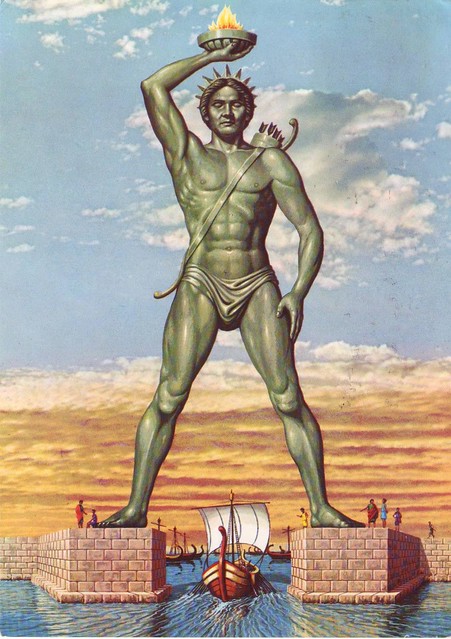
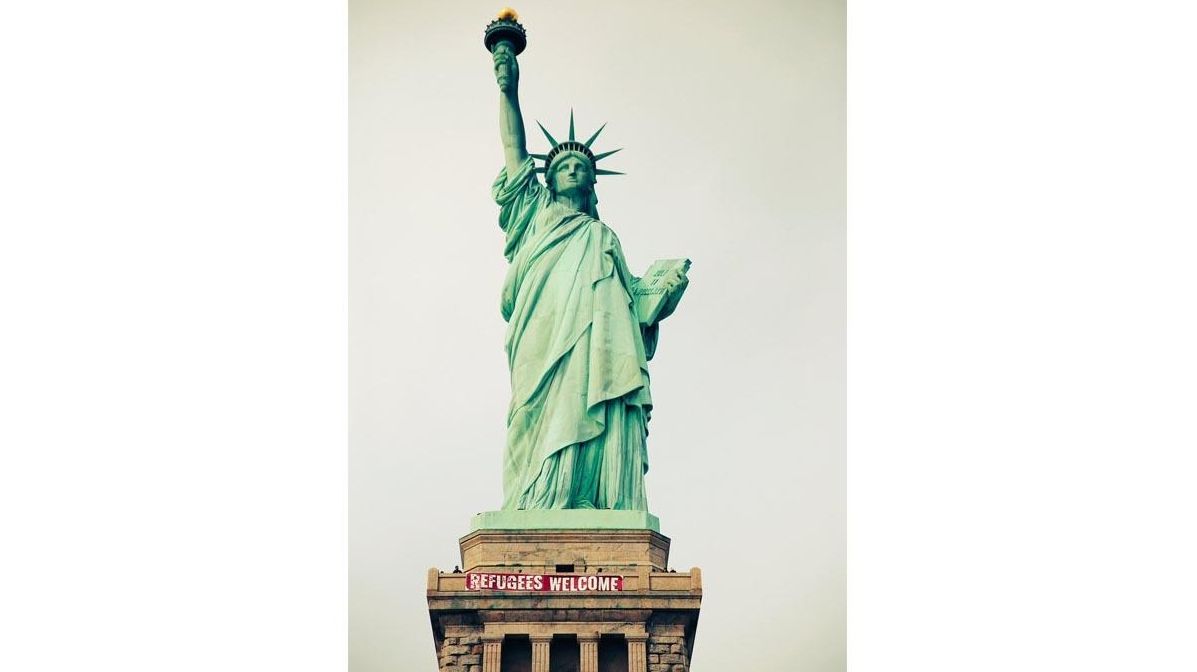
With the events of the last week and July 4th coming up, I can’t help but think of the Statue of Liberty and Jewish immigrant, Emma Lazarus’ poem at its base.  Though many of us are familiar with the second half of The New Colossus, the whole poem is striking              as it refers to the imposing Greek Colossus of Rhodes, pictured on the left.  The Colossus of Rhodes was the Greek titan-god of the sun, Helios, a symbol of power and military victory, which Lazarus then compares with the Statue of Liberty.

https://c1.staticflickr.com/5/4015/4550289647_46c24fcbe2_z.jpg
The Colossus of Rhodes

http://cdn.newsday.com/polopoly_fs/1.13157161.1487716102!/httpImage/image.jpg_gen/derivatives/landscape_1280/image.jpg
The Statue of Liberty


The poem reads:

Not like the brazen giant of Greek fame,
With conquering limbs astride from land to land;
Here at our sea-washed, sunset gates shall stand
A mighty woman with a torch, whose flame
Is the imprisoned lightning, and her name
MOTHER OF EXILES. From her beacon-hand
Glows world-wide welcome; her mild eyes command
The air-bridged harbor that twin cities frame.

"Keep, ancient lands, your storied pomp!" cries she
With silent lips. "Give me your tired, your poor,
Your huddled masses yearning to breathe free,
The wretched refuse of your teeming shore.
Send these, the homeless, tempest-tost to me,
I lift my lamp beside the golden door!"

Like Jesus in today’s gospel and the prophets and faithful throughout biblical and human history, the welcome of this poem, symbolized by the Statue of Liberty, isn’t a welcome for those who already fit in.  It isn’t a welcome to those willing to assimilate to the unassimilating culture that has become dominate in this country.  And it isn’t a welcome to those with the “right” belief, creed, politics, family, or connections.

The welcome of the Statue of Liberty, of Jesus, and of the prophets is a welcome to whoever is most in need of welcome, shelter, or refuge.  A cup of cold water sounds simple, but it can be the difference between life or death in the Sonoran Desert, provided at stations along the route of many immigrants to this country by organizations like Humane Borders and churches like la Iglesia Luterana San Lucas in Eagle Pass, Texas. 

Asylum-seekers, refugees, and immigrants come to this country for a million different reasons, and I wonder at the ways we do and do not welcome them.

This week, NPR’s The Takeaway reported about one of the three family detention centers in the united states where asylum-seekers are held until they are accepted as having a well-founded fear of future persecution or harm in their country of origin and then processed, which can take quite a while due to the current backlog.  The workers at the center refuse to drink the water provided to those being detained because it has been contaminated by nearby fracking and, although it is legally required in order to hold children, the detention center still hasn’t been certified as a childcare facility.  And yet, if you are a Thrivent member, your money supports the for-profit prison company,Corporate Corrections of America, which runs the facility.

This week the Supreme Court reinstated parts of the president’s travel ban, which, as Lutheran Immigration and Refugee Services (LIRS) states, “will mean individuals whom the U.S. has historically offered protection through the U.S. Refugee Admissions Program (USRAP) will be denied that protection – at least for now – despite their having been appropriately vetted through top security and intelligence agencies.”

Closer to home, in our most recent legislative session, language was included in the budget bill that will make it even harder to reinstate the ability of undocumented immigrants to obtain drivers’ licenses like they had been able to do in the past.

“Whoever welcomes you welcomes me, and whoever welcomes me welcomes the one who sent me,” Jesus says. “41Whoever welcomes a prophet as a prophet will receive a prophet’s reward; and whoever welcomes a righteous person as a righteous person will receive the reward of the righteous.”  It is in these, at times uncomfortable, encounters with prophets, little ones, the tired, the poor, the huddled masses, the wretched refuse, the homeless, tempest-tost that we receive Jesus’ rewards.

We are not the rewards, nor are those we might welcome, but it is in the very act of welcoming, that everyone involved receives Jesus’ reward.  It is in the relationship that forms, the connections created, and the love both given and received.  It is in the work of LIRS, joining together new immigrants and refugees with communities eager to welcome them to this country.  It is along the side of the highway when cars stop to help someone change a tire or get the help that they need.

God gives us glimpses of the reign of God as it will be, God shares a truth deeper than any government or news agency could report, and God uses us, the people we encounter, and the interactions themselves as their own prophetic, performance art and symbolic acts, which embody the Good News.  Through these acts, God welcomes each of us into the dominion of heaven and brings us all closer to the world and the country as we hope it will be.

Thanks be to God.

Sunday, June 25, 2017

God creates us as worthy: 3rd after pentecost


The holy gospel according to Matthew (10:24-39).

Jesus said:
“A disciple is not above the teacher,
      nor a slave above the master;
            25it is enough for the disciple to be like the teacher,
            and the slave like the master.
      If they have called the master of the house Beelzebul,
            how much more will they malign those of the master’s household!

26“So have no fear of them;
      for nothing is covered up that will not be uncovered,
      and nothing secret that will not become known.
      27What I say to you in the dark,
            tell in the light;
      and what you hear whispered,
            proclaim from the housetops.
                  28Do not fear those who kill the body but cannot kill the soul;
                        rather fear the one who can destroy both soul and body in hell.
      29Are not two sparrows sold for a penny?
            Yet not one of them will fall to the ground apart from your Father.
                  30And even the hairs of your head are all counted.
                        31So do not be afraid;
                              you are of more value than many sparrows.

32“Everyone therefore who acknowledges me before others,
      I also will acknowledge before my Father in heaven;
      33but whoever denies me before others,
            I also will deny before my Father in heaven.
34“Do not think that I have come to bring peace to the earth;
      I have not come to bring peace,
            but a sword.
      35For I have come to set a son against his father,
            and a daughter against her mother,
            and in-laws against one another;
            36and one’s foes will be members of one’s own household.
            37Whoever loves a parent more than me is not worthy of me;
                  and whoever loves a child more than me is not worthy of me;
                        38and whoever does not take up the cross and follow me
                              is not worthy of me.
                              39Those who find their life will lose it,
                                    and those who lose their life for my sake will find it.

The gospel of the lord.

-----

Jesus’ words in today’s gospel may seem harsh, but they are also familiar to many of us.  As a community of faith, you all decided to become a Reconciling in Christ congregation, which means that we specifically welcome lesbian, gay, bisexual, transgender, queer and questioning people as full participants in ministry.  We make this clear in our statement of welcome on our website as well as on our Reconciling in Christ Sunday each year. 

Part of welcoming people, especially if they belong to groups that have been and continue to be marginalized by the church is to continually learn about their experiences of the world—to seek to more fully understand their perspectives.

Today’s scripture gives us some insight into what many LGBTQ+ people experience in their lifetimes.

It’s hard to hear of children being set against their parents or in-laws being set against each other and not call to mind the 40% of homeless youth who are LGBTQ+, many of whom identify as transgender and most of whom have been kicked out of their homes by biological, foster, or adoptive parents.  What is even more striking is that this passage has been used harmfully by families to justify their own hatred towards their LGBTQ+ children.

Jesus’ presence does tend to stir things up.  Jesus’ life and gospel disrupts the systems—even our own families—that cause harm and create hierarchies that separate us from each other.  Jesus and his followers are a great example of a family of choice, created in place of the hierarchical structures dictated for them by their culture. 

Instead of reinforcing the hierarchy of the times, where women were property and children were nothing more than extra hands to work, Jesus creates a community where people of all genders have access to economic means and financially support the work so that whoever Jesus calls to follow him can become his disciple without constantly worrying about how they will make ends meet. 

Jesus chose disciples to be his family.  When his biological mother and siblings come to speak to him in Matthew 12, Jesus even goes so far as to say, “‘Who is my mother, and who are my siblings? … Here are my mother and mysiblings! For whoever does the will of my Father in heaven is my sibling andmother.”  Like many of us in the LGBTQ+ community, Jesus and the disciples chose their family and lived in community together as equals. 

For many LGBTQ+ folks, we choose people to be family with us.  Sometimes it is because our own families have disowned or distanced themselves from us.  Sometimes it is because our understandings of what it means to love one another as family are broader and deeper than simply those connected to us by blood.  Countless gay men in the 1980s embodied what it means to be family by choice as they sat with friends, partners, and loved ones the country seemed to have disowned, caring for them while they died of AIDS.  Still today, we in the LGBTQ+ community create new and more expansive families all the time.

And we as the church also follow Jesus’ lead in creating new and more expansive families today.  We welcome the newly baptized into the “family of God.”  We share with each other our moments of great joy and of great sorrow.  We choose each other to lead and serve as there is both need and ability.  We live out our faith as LGBTQ+ people have been living out our lives, creating community and family through both necessity and love, finding people who love us exactly for who we are not in spite of or apart from our identities.

And yet, the culture around us, which still dictates worth in terms of earning potential, declares those who don’t fall in line with hierarchical norms as worth         less, and maybe even altogether worthless.  Declarations of worthlessness from the culture and the church keep some LGBTQ+ people in the closet for their whole lives and others for far too long, causing mental, emotional, and spiritual harm. 

Even those of us who do come out to ourselves and others and have family and communities that support us usually wrestle with our identity and especially our faith, because we have heard so many times that we are not worthy of God’s love, of rights and acceptance in our country, even, as many transgender women of color know all too well, of life itself. 

Jesus’ words are harsh, but maybe that’s the point.  None of us are worthy of Jesus on our own.  But we’re not alone.  We’ve never been alone.  God has always been our Creator, knitting us together in utero, counting every hair on our head.  There is no being worthy on our own and there is no alone.  God is always with us, even deep back in the closet by the lost socks, in the midst of anxiety, and in the fear of what others might think.  Jesus is with us.

Each thing we do matters to God.  Not because God is going to deduct points or dole out punishment for every screw up, however big or small, but because we each matter to God.  Because God cares about us and loves us.  God loves our queerness.  God loves our languages.  God loves our courage, our hair, our compassion, our knees that get stiff when it rains—God loves every single bit of us.  Even when family or friends might distance themselves or put up a wall against us, Jesus assures us that we “are of more value than many sparrows.”

In a world that marks worth in dollar signs, the dominion of heaven marks your worth as inherent.  You exist because you are worthy.  God creates each unique person out of love, claiming us again in baptism, whispering “I love you” in the sighs of new parents or friends late at night, in the chirp of birds, rustle of leaves, and drops of rain; and proclaiming it from the housetops in the cry of a newborn, the roar of a lion, the clap of thunder.

God’s family is a family of choice—even under dire circumstances, against the world’s values, God chooses you.  God will always choose you.  Every you that there ever is. 

Thanks be to God.

Sunday, June 18, 2017

Christ is the hope that does not dissapoint us: 2nd post-pentecost a


The second reading is from Romans (5:1-8).
 
Therefore, since we are justified by faith,
      we have peace with God through our Lord Jesus Christ,
            2through whom we have obtained access to this grace in which we stand;
            and we boast in our hope of sharing the glory of God.
            3And not only that,
                  but we also boast in our sufferings,
                        knowing that suffering produces endurance,
                        4and endurance produces character,
                        and character produces hope,
                        5and hope does not disappoint us,
                              because God’s love has been poured into our hearts
                                    through the Holy Spirit that has been given to us.

6For while we were still weak,
      at the right time Christ died for the ungodly.
      7Indeed, rarely will anyone die for a righteous person—
            though perhaps for a good person someone might actually dare to die.
                  8But God proves God’s love for us
                        in that while we still were sinners Christ died for us.


The holy gospel according to Matthew (9:35-10:8).

35Then Jesus went about all the cities and villages,
      teaching in their synagogues,
      and proclaiming the good news of the dominion of heaven,
      and curing every disease and every sickness.
            36When he saw the crowds,
                  he had compassion for them,
                        because they were harassed and helpless,
                              like sheep without a shepherd.
                  37Then he said to his disciples,
                        “The harvest is plentiful,
                              but the laborers are few;
                              38therefore ask the Lord of the harvest
                                    to send out laborers for the harvesting.”

10Then Jesus summoned his twelve disciples
      and gave them authority over unclean spirits,
            to cast them out,
            and to cure every disease and every sickness.

2These are the names of the twelve apostles:
      first, Simon, also known as Peter,
            and his brother Andrew;
      James son of Zebedee,
            and his brother John;
      3Philip and Bartholomew;
      Thomas and Matthew the tax collector;
      James son of Alphaeus,
            and Thaddaeus;
      4Simon the Cananaean,
      and Judas Iscariot,
            the one who betrayed him.

5These twelve Jesus sent out with the following instructions:
      “Go nowhere among the Gentiles,
      and enter no town of the Samaritans,
            6but go rather to the lost sheep of the house of Israel.
                  7As you go, proclaim the good news,
                        ‘The dominion of heaven has come near.’
                  8Cure the sick, raise the dead, cleanse the lepers, cast out demons.
                        You received without payment;
                              give without payment.

The gospel of the Lord.

-----

Paul’s letter to the Romans states: “suffering produces endurance, 4and endurance produces character, and character produces hope, 5and hope does not disappoint us.”  But what kind of hope is Paul talking about in this letter to the Romans?  And what kind of suffering for that matter?  Is suffering truly redeemable?  Can any good come from suffering?

There is plenty of suffering that cannot be redeemed.  The suffering of victims of abuse, who are so often trapped in abusive relationships and situations by circumstances beyond their control.  There is no redemption of that abuse because it is not freely chosen, there is no larger purpose.  Those who perpetrate abuse perpetrate evil.

The suffering in death of Philando Castile was not the kind of suffering that can be redeemed.  The suffering and death of those who were murdered two years ago yesterday at Mother Emanuel African Methodist Episcopal Church in Charleston because a white ELCA member didn’t like that they were Black is not the kind of suffering that can be redeemed.  People of color who are killed and harmed and harassed for simply existing deserve better. 

White supremacy and white privilege, parts of what we know as racism literally kill people of color.  People of color become the crowds Jesus encounters—harassed and helpless, oppressed and thrown to the ground, because of a system that tries to dehumanize them and then refuses to convict those who kill them.  To not speak up, to not name that killing another person is evil, to not name that #BlackLivesMatter reinforces the evil of white supremacy.  It becomes complicity in a system that harms our siblings, friends, and neighbors.

Suffering these abuses and deaths is not the suffering that Paul is lifting up in his letter to the Romans.  Paul is writing to the Early Church in Rome, to which he will soon journey, and where he will be arrested and executed.  This church, this community of faith in Rome is suffering persecution for their faith—gathering in secret in underground catacombs, fearing arrest, torture, and death for their hope. 

I can imagine them resonating deeply with the crowd described in our gospel reading, being “harassed and helpless, like sheep without a shepherd,” and even moreso with a more literal translation of the crowds being “oppressed and thrown to the ground.”

Their suffering is not the suffering that is not redeemable.  Rev. Dr. Martin Luther King, Jr. spoke of the suffering he and others, like Bayard Rustin and Rosa Parks, experienced during the Civil Rights Movement.  While those who perpetrate violence always enact evil, those who, like the ones who participated in the Civil Rights Movement, willingly endure suffering for the sake of a larger struggle for justice, embody the suffering that does produce endurance. 

It is suffering for a larger purpose—to expose injustice for what it is—that produces the endurance Paul talks about.

This endurance is the ability for Mildred and Richard Loving to persevere in their relationship in the face of a country that said interracial marriage was wrong.  This endurance is the endurance of those who know our participation in struggles for justice help make the “arc of the moral universe” bend towards justice, not on accident or by default, but on purpose and with intentionality and hard work. 

This past week marked 50 years since the Lovings won their Supreme Court case against the state of Virginia, ensuring the right to marry not be restricted by race, and laying some of the groundwork to guarantee those of us who are lesbian, gay, bisexual, transgender, and queer the right to marry who we want.

The endurance of people like the Lovings does produce character—the kind of character that trusts the God who is love to be at work in others and who notices God in others.  This character is evident in those in our community who go out of their way to make others feel welcome, those who know what it is to be left out and work to make sure others do not know that isolation, harassment, or helplessness. 

This character, born of long fought for endurance, is the kind that talks to people when they are worried that someone is being abused, struggling to make ends meet, or lost in the isolation of physical or mental illness.  This character recognizes the value and worth of people of color and other marginalized group—knows the pain of sending children into the world each day, wondering if they will make it back home safely.  This character is intimate with the gut wrenching compassion that moves Jesus to not only teach, preach, and heal, but also send out the disciples for this work of the dominion of heaven.

This character also knows the hope of which Paul writes.  This hope that does not disappoint us.

But we are disappointed by hope all of the time.  When we hope for a child and are faced with miscarriages or illnesses.  When we hope a relationship will last forever and are disappointed to find that divorce is the reality we need or face.  When we hope a guilty verdict will finally bring a glimpse of justice, yet once again hear “not guilty” ring out.  When we hope a building will serve all of our needs, but we are disappointed to find we cannot make it accessible and the constant repairs are restricting our ability to be in mission.  This is not the hope we seek.  This is not the hope Paul is talking about.

The hope that Paul proclaims is a deeper hope.  It’s not a secret wish or unstated expectation that all will be well or go as planned.  The hope that does not disappoint us is the hope in our God whose whole being is love.  Hope in our God who loves us so much that God comes to live with us—to be and become us, even knowing that our response to that love is too often violence, exclusion, harassment, and even execution on the cross. 

Hope in the God who responds even to the most violent of deaths with new life in the resurrection.  Hope in a God who makes a way out of no way, who takes the unexpected and loves it into new life, who creates meaning and purpose when we can’t imagine anything like it.

The hope that does not disappoint us is the hope in a God who takes our failed attempts, our heart break, our personal disasters, and then as Paul states, pours out their love “into our hearts through the Holy Spirit that has been given to us.”

Our hope, when placed in the God who changes with and for us, does not disappoint, because Jesus comes for each one who is sick, harassed, and helpless and gives the fullest measure of devotion not only in death, but then even further in new resurrection life.  Because Christ died for us so we can live in hope with Christ that death is not the ultimate power, that racism will not win, that violence doesn’t reign supreme, but instead our hope in Christ is assured because love wins, justice will reign, and peace will rule the earth. 

Thanks be to God.

Sunday, June 04, 2017

The Holy Spirit Stirs us up: pentecost a


The first reading is Acts 2:1-21.
The second reading is 1 Corinthians 12:3b-13.

The holy gospel according to John (20:19-23)

19When it was evening on that day,
      the first day of the week,
            and the doors of the house where the disciples had met
                  were locked for fear of the religious authorities,
      Jesus came and stood among them and said,
            “Pokoj vám!”
            “La paz sea con ustedes.”
            “Frieden sei mit euch.”        
            “Peace be with you.” 
            [“Peace be with you.” in ASL]
         20After Jesus said this,
            he showed them his hands and his side.
                  Then the disciples rejoiced when they saw the Lord.
      21Jesus said to them again,
            “Pokoj vám!”
            “La paz sea con ustedes.”
            “Frieden sei mit euch.”         
            “Peace be with you.”
            [“Peace be with you.” in ASL]
                  As the Father has sent me,
                        so I send you.”
      22When he had said this,
            Jesus breathed on them and said to them,
                  “Receive the Holy Spirit.
                        23If you forgive the sins of any,
                              they are forgiven them;
                        if you retain the sins of any,
                              they are retained.”

The gospel of the Lord.

-----

I love birthdays!  They are the one day of the year that a person—unless they’re a twin—gets to be the focus.  For that one day, everybody celebrates this person’s life, the ways they’re meaningful to them, and hopes for their life to come.

I also love the ways that different cultures celebrate birthdays.  Some cultures have unique parts of every birthday celebration.  Growing up, we always sang happy birthday—holding the last note purposefully off-key for as long as we could—the birthday person made a wish, and then attempted to blow out all of the candles on the cake in one breath.

While I was in Slovakia with the ELCA’s Young Adults in Global Mission program, I learned of a tradition that had been lost in my family since my dad’s ancestors came over from Central Europe.  It is a tradition that I have carried with me since my time in Slovakia to varying degrees.  In Slovakia and other Central European countries, it is customary to bless the birthday person.

While I usually leave the shot of palinka or slivovica out of my blessings, with close friends and family, I make a point of blessing them and the new year of life that they are beginning.  I try to be realistic and hopeful in my blessings, so that someone who gave birth or is pregnant might be blessed with new experiences, and also sleep, or that someone who has been at the forefront in work towards a moral and just state budget is blessed with and in the struggle and also with triumph.  Each blessing becomes its own unique celebration.

In some cultures, certain birthdays are particularly important.  In Mexico, quinceañeras, or 15th birthdays, are a particularly big deal.  As I was reflecting on and reading about Pentecost, which we typically consider the birthday of the church, I was reminded of Korean traditions around first birthdays.  In Korean culture, the first birthday is a big deal.  I’m sure D told many of you about her granddaughter’s first birthday, so I will just mention the thing that most stuck with me, especially as Rev. Theresa Cho wrote about her family’s celebrations in an article in the Christian Century.[i]

One main part of the first birthday dol or doljanchi, “a ceremony in which the child is blessed with a prosperous future,” is a table set out with a variety of different objects.  The objects represent types of prosperity.  The child is then placed before the objects and whichever object the child chooses represents the destiny that child claims.

What captivated me in Rev. Cho’s explanations of the objects was the openness to interpretation: the golf ball her first child chose could be a symbol for athleticism or for being a quick thinker.  When her other child chose grapes instead of any of the items laid out, it could signify a healthy appetite or the self-assuredness to determine their own destiny—to take the less obvious path.

As we celebrate the birthday of the universal church and particularly this year’s momentous 500th Reformation anniversary and the accidental birth of Protestantism, we too have destinies laid out for us.  And these destinies are the ones that have been laid out for millennia.

In Acts, Peter points back to the prophet Joel, saying, “In the last days it will be, God declares, that I will pour out my Spirit upon all flesh, and your children shall prophesy, and your youth shall see visions, and your elders shall dream dreams. 18Even upon my slaves of all genders, in those days I will pour out my Spirit; and they shall prophesy.”  This destiny is laid out for us and though we may not know what it will look like or what Joel and Peter mean, it is a destiny of new hope, change, and new life.

In 1 Corinthians, Paul sets before us some of the gifts of the Spirit: the utterance of wisdom, utterance of knowledge, faith, gifts of healing, working of miracles, prophecy, discernment of spirits, various kinds of tongues, and interpretation of tongues.

None of us possess all of these.  Many of us possess at least one of these, and some of us possess other gifts that aren’t listed here.  But as we sit with them spread out before us, not knowing quite what they will mean or how the Holy Spirit will use us or our destinies, one thing is certain: the Holy Spirit is at work.  She has come as tongues of fire and rushing wind, she has come in languages we do and do not understand, she has come in water, wine and bread, and she brings with her upheaval of the systems that harm us and all of creation and she brings new life to everyone.

Sometimes the work of the Holy Spirit makes us uncomfortable, sometimes defensive, and sometimes confused.  But these are good things!  They are blessings, because it is in struggling and being uncomfortable that we learn from each other and about ourselves.  The Holy Spirit rarely calls people to what is comfortable, but she does bless us with what is meaningful, which is ultimately life-giving.

The gifts and blessings of the Holy Spirit on this birthday of the church and each day are gifts of diversity and difference—new ways of being and connecting.  The Holy Spirit changes us and gives us new ways to proclaim with Jesus, “Pokoj vám.” “La paz sea con ustedes.” “Frieden sei mit euch.” “Peace be with you.” [Peace be with you in ASL].

Amen.


[i] https://www.christiancentury.org/article/2015-04/may-24-day-pentecost